Published: January 2, 2026 Category: Sex Addiction & CSBD Treatment
Ten years ago, sex addiction was widely viewed as a problem of consumption—a private struggle fought with magazines or videos. In 2026, it has mutated into a problem of interaction.
The "buffer time" that once existed between the urge and the action has vanished. Just as sports betting apps turned every Sunday football game into a 24/7 casino, "Creator Platforms" (like OnlyFans, Fansly, and AI companions) have turned intimacy into a pay-per-view transaction that never sleeps.
We are witnessing a fundamental shift in how Compulsive Sexual Behavior Disorder (CSBD) presents in treatment. The men and women walking through our doors today aren't just addicted to the act of viewing content. They are addicted to the anticipation of a reply. They are caught in a "parasocial" loop—paying for digital affection from a persona who may not even be the one typing the messages.
This isn't just a moral crisis; it is a financial and neurological emergency. In 2024 alone, the leading creator platform generated over $7.2 billion in revenue—driven not by casual subscribers, but by a small percentage of "whales" chasing a feeling that money simply cannot buy.
At Prescott House, we believe you cannot fight a modern addiction with outdated tools. This guide examines the hard statistics of sex addiction in 2026, the rise of "financial domination," and why the most dangerous drug of the year isn't a substance—it's a notification.
The 2026 Compulsive Sexual Behavior Disorder (CSBD) Statistical Landscape
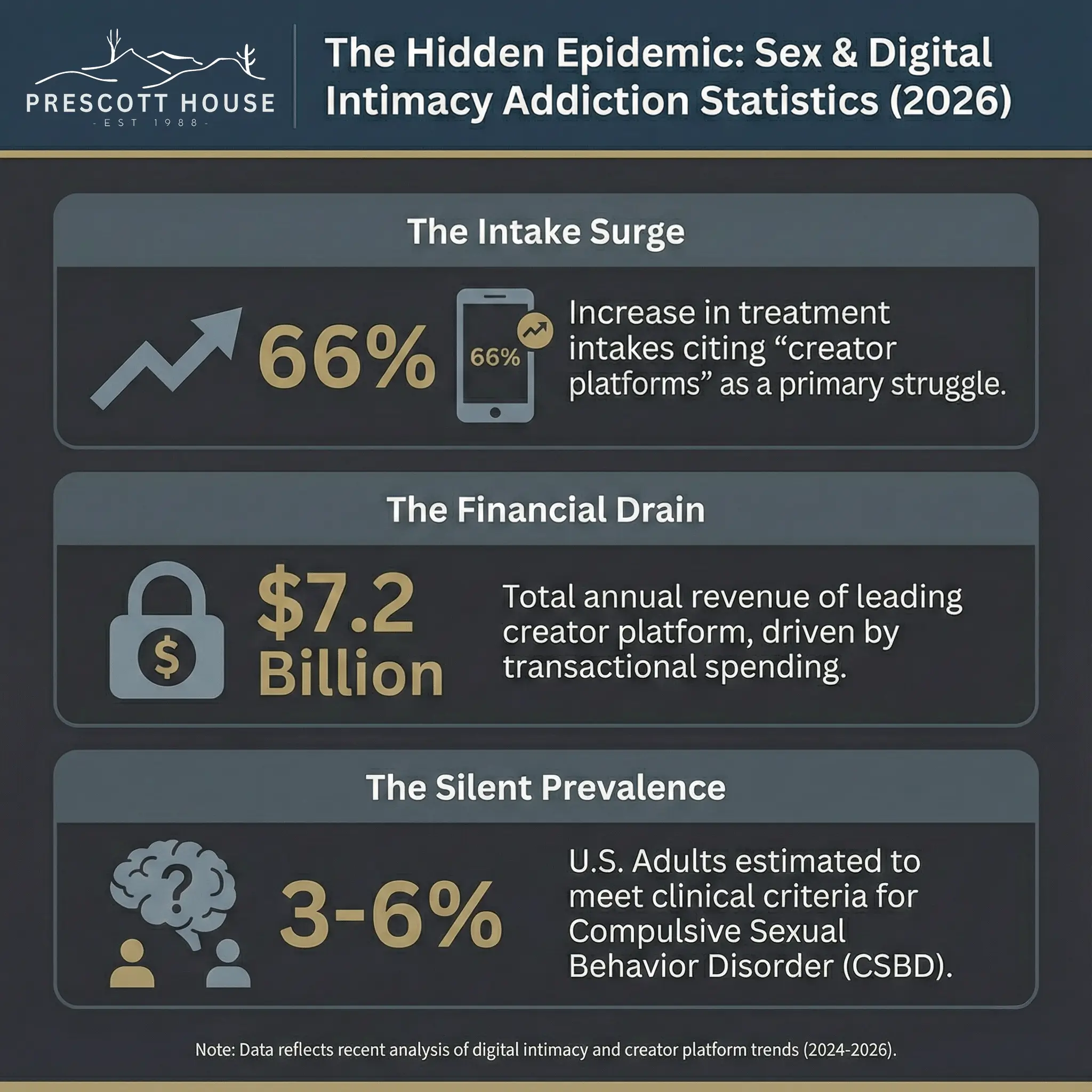
Before understanding the psychology, we must look at the reality of the numbers. The data from 2024–2026 paints a picture of an addiction that is becoming more expensive, more accessible, and more difficult to treat without professional intervention.
- The "Daily Spend"
- Globally, users spend roughly $19.7 million per day on the leading creator platform alone (based on reported annual revenues of ~$7.2 billion).
- Source: Hypebeast: OnlyFans 2024 Revenue Report | Cross-Border Magazine: Spending Analysis
- The "Addiction Surge"
- Addiction centers in the UK and US have reported a 66% year-over-year increase in intakes specifically citing "creator platforms" as their primary struggle.
- Source: Canopy: OnlyFans Addiction Statistics | Recovery Lighthouse: The Impact of Creator Platforms
- The "Micro-Transaction" Trap
- Financial analysis indicates that the majority of revenue growth on these platforms comes from transactional spending (pay-per-view messages, custom videos) rather than base subscriptions.
- Source: European Business Magazine: Consumer Spending Trends
- Prevalence
- An estimated 3–6% of U.S. adults meet the clinical criteria for Compulsive Sexual Behavior Disorder (CSBD).
- Source: PubMed: Compulsive Sexual Behavior Prevalence | The Science Breaker: CSBD Statistics
- The Suicide Risk
- Individuals with untreated CSBD face a significantly elevated suicide risk, with studies showing suicide attempt rates as high as 9.1% in clinical samples (comparable to or exceeding gambling disorder rates).
- Source: NIH: Prevalence of Suicidal Behavior in Behavioral Addictions | Addiction Help: Sex Addiction Statistics
The Rise of Synthetic Intimacy (AI on Demand)
The most dangerous shift in 2026 is not human; it is synthetic. "AI Companions" and generative pornography have moved from niche novelties to mainstream addictions. These tools offer something human partners cannot: total compliance and hyper-personalization.
The Data on AI Addiction (2025-2026):
- Rapid Attachment: A 2025 behavioral report found that 45% of users reported feeling a genuine emotional attachment to their AI companion within just three weeks of use. (Source: Market.us Analysis)
- Daily Engagement: The average user interacts with top AI companion apps for over 90 minutes per day, a retention rate that eclipses most social media platforms. (Source: ElectroIQ Statistics)
- The "Perfect Drug": Generative AI allows users to customize every physical and personality trait of their "partner." This creates a "supernormal stimulus"—a reward signal so intense that real human interaction feels dull by comparison.
Why It Hooks the Brain:Real relationships have friction. People have bad days, disagreements, and boundaries. AI companions do not. They are programmed to mirror the user’s desires perfectly. This lack of friction removes the risk of rejection but also removes the possibility of genuine connection. The user bonds with a mirror, not a person.
The Parasocial Trap: Intimacy Without Vulnerability
To understand why men are going into debt for digital content, we must understand the psychological mechanism at play: Parasocial Interaction.
Clinically, a parasocial relationship is a one-sided bond where one person extends emotional energy, interest, and time, and the other party (the persona) is completely unaware of the other's existence.
In the past, this was felt for celebrities or news anchors. In 2026, technology has weaponized this dynamic.
- The Illusion of Reciprocity: Unlike a TV character, a Creator or AI responds. When a user pays for a custom message, the brain registers it as a genuine social interaction, releasing oxytocin (the bonding chemical).
- Safety from Rejection: Real relationships require vulnerability and carry the risk of rejection. Parasocial relationships are "safe." As long as the payment clears, the validation continues.
- The "Perfect" Partner: These relationships offer "Intimacy on Demand." The digital partner never has a bad day, never argues, and is always available. This creates a "supernormal stimulus" that makes real-life partners seem difficult or high-maintenance by comparison.
The Danger: The brain cannot easily distinguish between a "paid" bond and a "real" bond. The emotional attachment is real to the user, even if the relationship is transactional to the creator. This is why the withdrawal from these platforms often mimics the grief of a real breakup.
Watch this great video that we believe goes a long way in understanding things like Parasocial Relationships and the like here is a great video from Dr. Alok Kanojia on the youtrube channel HealthyGamerGG.
The Financial Toll of "Custom" Reality
The financial devastation of this addiction often goes unnoticed. While the rising debt associated with sports betting addiction statistics frequently makes headlines, the economic toll of digital intimacy remains largely hidden in credit card statements and "entertainment" fees. The mechanics, however, are nearly identical.The Economics of Modern Sex Addiction
- The "Micro-Transaction" Trap: While sites like OnlyFans are known for subscriptions, the real addiction engine is hidden. Financial analysis reveals that 88% of revenue growth comes from transactional spending (pay-per-view messages, custom videos) rather than base subscriptions. (Source: MatthewBall.co Economics)
- The Scale of Spending: In 2024 alone, the leading creator platform generated $7.2 billion in gross revenue, a 9% increase from the previous year. This revenue is driven almost entirely by users seeking personalized attention. (Source: Hypebeast 2024 Report)
- Debt Accumulation: We are seeing a rise in "financial infidelity" where users hide $10,000 to $50,000 in credit card debt. This debt is rarely for physical affairs; it is almost exclusively for digital access and custom content.
The Neuroscience of "Interactive" Dopamine
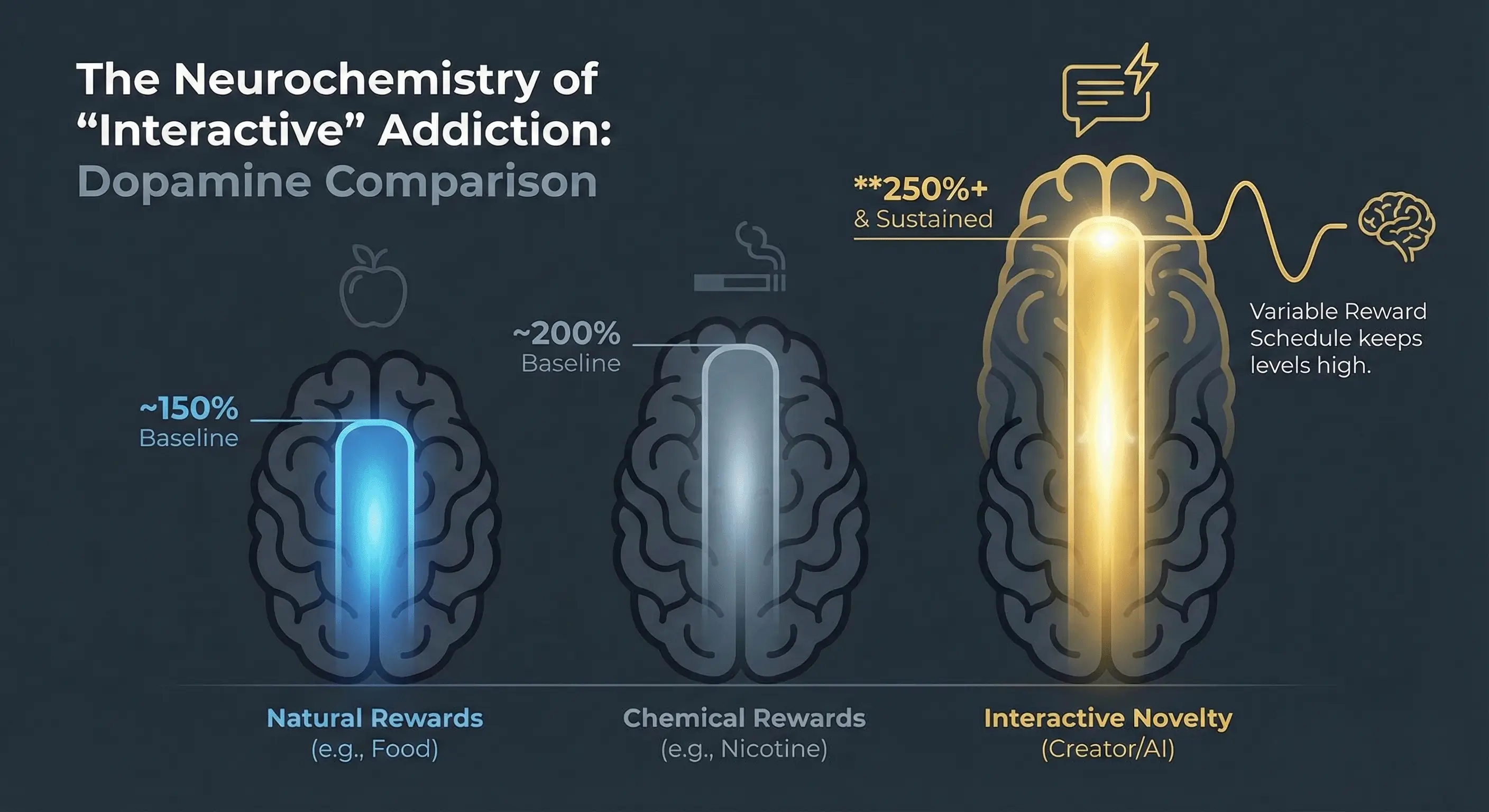
Why is this form of addiction so hard to break? The answer lies in how the brain processes "variable rewards."
The "250%" Dopamine SpikeTraditional rewards like food release a moderate amount of dopamine (about 150% of baseline). Nicotine releases roughly 200%. Research suggests that sexual novelty—specifically the anticipation of a new sexual experience—can spike dopamine to 250% or higher. When you add the "interactive" element of a chat bot or creator, the brain remains in this high-dopamine state for hours.
The Slot Machine EffectWhen a user sends a message to a creator or AI, they do not know when—or if—they will get a reply. This uncertainty creates a state of "arousal and anxiety."
- The Wait: The brain releases stress hormones (cortisol) while waiting.
- The Ping: When the reply arrives, the brain floods with dopamine to relieve the stress.This cycle creates a chemical bond that is incredibly difficult to break without professional help. It is not just a habit; it is a neurochemical loop.
Warning Signs of "Digital Intimacy" Disorders
Because this addiction lives on a smartphone, it is easy to hide. However, the behavior leaves traces. Use this checklist to identify if a habit has crossed the line into a disorder.
The "Digital vs. Reality" Checklist
- Escalation: Do you find yourself needing more extreme or "custom" content to get the same level of excitement?
- Preference for Digital: do you find yourself avoiding real intimacy with a partner because it feels like "too much work" compared to the app?
- Financial Infidelity: Have you ever hidden a credit card statement, taken out a loan, or used a "secret" account to pay for content?
- Withdrawal: Do you feel irritable, anxious, or depressed when you cannot access your phone or the platform?
- Risk Taking: Do you view content or message creators while at work, driving, or in public spaces?
Reclaiming Real Connection
In 2026, sex addiction is no longer just about lust. It is about loneliness. You are not just fighting a "bad habit"; you are fighting a multi-billion dollar algorithm designed to monetize your need for connection.
The first step to winning this battle is recognizing the enemy. It is not the creator, and it is not the technology. It is the isolation that makes the technology feel like a solution.
At Prescott House, we specialize in untangling the complex web of Compulsive Sexual Behavior Disorder. We help men and women rewire their brains for real intimacy, not the paid imitation.
The hardest step is the first one. But it is the only one that leads back to reality.
References
- Hypebeast (2025). OnlyFans 2024 Revenue Report: The $7.2 Billion Surge. Link
- Canopy (2025). OnlyFans Addiction: The Rise of the Digital Intimacy Disorder. Link
- MatthewBall.co (2024). The Economics of OnlyFans: Why Transactional Spending Drives Growth. Link
- Market.us (2025). Global AI Companion App Market Analysis & Addiction Trends. Link
- National Institutes of Health (NIH). Prevalence of Suicidal Behavior in Behavioral Addictions. Link
- Journal of Behavioral Addictions. Compulsive Sexual Behavior Disorder: Prevalence in the United States. Link
Finding the Right Path to Recovery
Recovery from digital intimacy disorders is not one-size-fits-all. The treatment depends on whether your struggle is primarily driven by the content (pornography) or the connection (attachment). At Prescott House, we offer specialized pathways for each:
- For Content-Driven Struggles: If your battle is primarily with the compulsive consumption of content, we provide specialized Pornography Addiction Counseling to address the behavioral roots.
- For Long-Term Healing: Breaking the cycle is only the beginning. Our Porn Addiction Recovery programs focus on rebuilding the brain’s reward system and restoring healthy dopamine baselines.
- For Emotional & Parasocial Attachment: As discussed in this report, many modern addictions involve an emotional bond with a creator or AI. This often mirrors "Love Addiction." We treat these intimacy disorders through our Love Addiction Treatment Center, helping men distinguish between paid validation and real connection.
You do not have to fight this algorithm alone.
If you are ready to reclaim your life, finances, and relationships, reach out to our team today. We are here to listen.