It usually does not start with a dramatic moment. It starts with a habit that feels manageable. A routine that nobody else knows about. A pattern you keep telling yourself you will deal with later.
For many men, the question of whether they have a sex addiction does not come from hitting rock bottom. It comes from a quiet, persistent feeling that something is off. That the behavior has taken on a life of its own. That trying to stop feels harder than it should.
If you have been asking yourself that question, you are not alone. And the fact that you are asking it matters.
The Difference Between a High Sex Drive and a Sex Addiction
This is the question most men get stuck on. And it is a fair one.
A healthy libido is not a problem. Wanting sex frequently is not a problem. The difference between a high sex drive and a sex addiction comes down to two things: control and consequences.
With a high sex drive, you are in control. With a sex addiction, the behavior is in control of you.
Here is what that looks like in practice. A person with a high sex drive can choose not to act on an urge when the timing is wrong. A person struggling with sexual addiction often cannot, even when the consequences are real and obvious. They may miss work. Damage their relationship. Spend money they do not have. Break promises they genuinely intended to keep.
The behavior continues not because it feels good anymore, but because stopping feels impossible.
Common Signs That Sexual Behavior Has Become a Problem
Sex addiction does not look the same for every person. For some men it centers on pornography. For others it is compulsive hook-ups, affairs, cam sites, or excessive masturbation. The specific behavior matters less than the pattern surrounding it.
These are the signs that clinicians look for when assessing whether sexual behavior has crossed into addiction territory.
You have tried to stop and could not. This is one of the clearest indicators. If you have made a genuine decision to change a sexual behavior and found yourself unable to follow through repeatedly, that is worth paying attention to.
The behavior is getting harder to hide. Secrecy is a core feature of sexual addiction. If you are spending significant energy managing what other people know about your behavior, that is a sign the behavior has taken on more weight than you intended.
You use sexual behavior to manage your emotions. Many men with sex addiction are not chasing pleasure. They are chasing relief. Sex, pornography, or fantasy becomes the primary way to manage stress, loneliness, anxiety, or emotional pain. When that happens, it functions exactly like any other addictive substance.
Your relationships are suffering. Partners, family members, and close friends often notice changes before the person struggling does. Arguments about pornography, emotional distance, unexplained absences, or a breakdown in intimacy are all common.
You feel shame after, but keep going anyway. This cycle of behavior followed by guilt followed by behavior again is one of the most painful features of sexual addiction. The shame does not stop the behavior. For many men it actually drives it.
Why Sex Addiction Is Hard to Recognize
Part of what makes sexual addiction difficult to identify is that sex is a normal part of life. Unlike alcohol or drugs, there is no clear line between use and misuse that everyone agrees on. That ambiguity makes it easy to rationalize.
It also carries more shame than almost any other addiction. Men who would readily tell a friend they are struggling with drinking will go years without telling anyone about compulsive sexual behavior. The silence makes the problem worse and the isolation deeper.
Dr. Patrick Carnes, the leading researcher on sexual addiction and the architect of the treatment model used at Prescott House and Gentle Path at The Meadows, spent decades documenting how shame and secrecy fuel the addiction cycle rather than contain it. His research showed that most men struggling with sexual addiction had been managing it alone for years before seeking help.
That gap between when the problem starts and when someone reaches out is where the most damage tends to happen.
What the Sexual Addiction Screening Test Actually Measures
The most widely used clinical tool for identifying sexual addiction is the Sexual Addiction Screening Test, known as the SAST. It was developed by Dr. Patrick Carnes and has been used by clinicians and treatment programs worldwide for decades.
The SAST does not ask how often you have sex or how many partners you have had. It focuses on the behavioral and emotional patterns that research has consistently linked to sexual addiction. Things like loss of control, preoccupation, consequences, and shame.
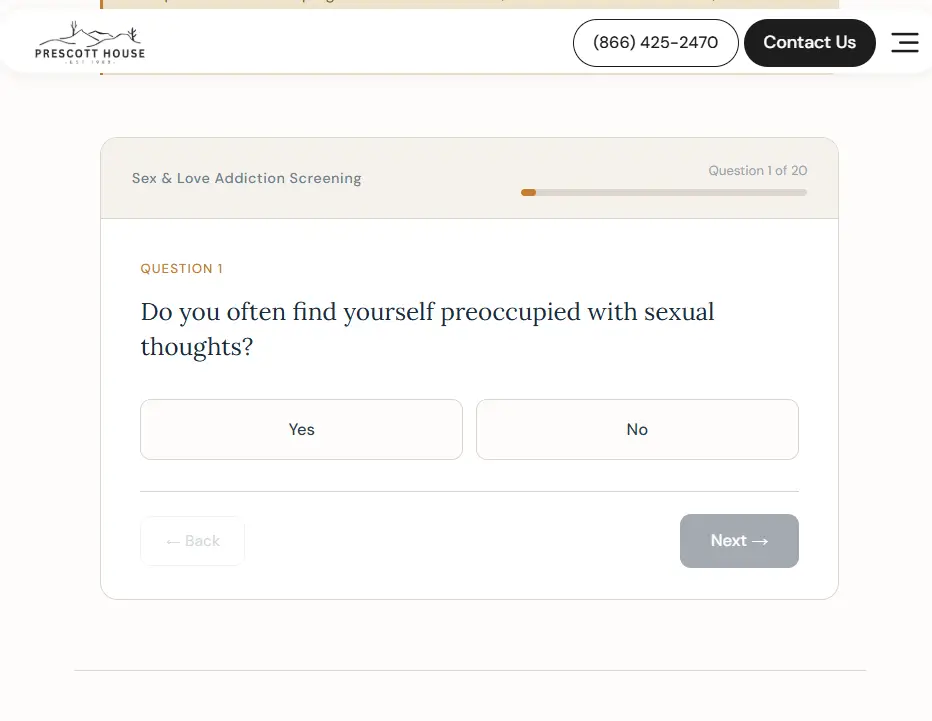
We recently rebuilt our sex addiction test from the ground up using the SAST framework. It asks 20 questions, delivers scored results across three tiers, and takes about three minutes. It is completely confidential and nothing is stored.
If you have been sitting with the question of whether your behavior has become a problem, the test is a good place to start. Not because a quiz can replace a clinical evaluation, but because honest answers to the right questions can cut through a lot of the rationalization that keeps men stuck.
Take the sexual addiction screening test here: prescotthouse.com/do-i-have-sex-love-addiction
What Happens If Your Score Is High
A high score on the SAST does not mean you are broken or that your life cannot change. It means your responses are consistent with patterns that typically respond well to professional support.
At Prescott House, we treat men dealing with sexual addiction in a residential program grounded in Dr. Carnes' 30 Task Model. Our certified sex addiction therapists work closely with Gentle Path at The Meadows and understand that sexual addiction is almost always connected to something deeper. Trauma, attachment wounds, shame, and emotional dysregulation are almost always part of the picture.
Treatment addresses all of it, not just the surface behavior.
If you want to talk through what your results mean or what support might look like, our admissions team is available for a confidential conversation with no pressure and no obligation.
Call us at (866) 425-2470 or visit prescotthouse.com/sex-addiction-treatment to learn more about the program.
Prescott House is a men's residential treatment center in Prescott, Arizona specializing in sexual addiction, gambling addiction, and co-occurring mental health disorders. Our clinical team includes certified sex addiction therapists (CSATs) and we are recognized by IITAP.
You might also find these helpful
- Do I Have a Sex Addiction? Take the Screening Test
- Men's Sexual Addiction Treatment at Prescott House
- What Is Love Addiction and How Is It Different