When Superman Bleeds
If you were to construct the perfect modern deity, he would look a lot like Eldrick Tont "Tiger" Woods in the early 2000s. He was a man carved out of granite and statistical inevitability, a figure who didn't just play golf but seemed to bend the physics of the universe to his will. He was the "Chosen One," a prodigy who had been swinging a club on national television since he was a toddler, groomed for greatness in a laboratory of high expectations and unparalleled discipline. To the public, Tiger was not a human being; he was a machine. He was the "Terminator" in Sunday red, a stoic assassin who dismantled opponents with a surgical precision that bordered on the supernatural. He was safe. He was corporate. He was the guy you wanted on your cereal box, your watch, and your television screen.
And then, in the early hours of November 27, 2009, the machine malfunctioned.
The incident itself—a slow-motion, low-speed collision with a fire hydrant and a neighbor's tree at 2:30 in the morning—was almost comical in its banality.1 It lacked the dramatic flair of a high-speed chase or a cinematic explosion. Instead, it was a messy, confused, suburban fender-bender involving a Cadillac Escalade and, reportedly, a very angry wife wielding a golf club. But that crumpled SUV was the first crack in the dam. What poured out in the days, weeks, and months that followed was not just a story of a celebrity behaving badly; it was a torrential flood of secrets that washed away the meticulously crafted image of the perfect family man.
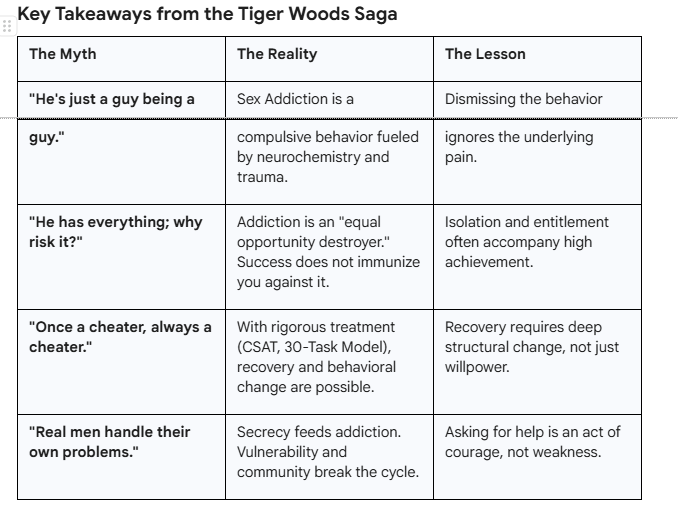
As the "blue curtain" of Tiger’s privacy was ripped down, the world was treated to a parade of cocktail waitresses, porn stars, and nightclub hostesses, each carrying a piece of the puzzle that was Tiger’s "secret sexual basement".1 The media frenzy was unprecedented. Late-night comedians had a field day, turning the scandal into a global punchline. "Sex addiction" became the buzzword of the year, often delivered with a sarcastic roll of the eyes. To the cynic, it looked like the ultimate "Get Out of Jail Free" card—a convenient clinical label slapped onto a rich man’s hedonism to salvage his endorsements.
But here at Prescott House, we didn't laugh. We didn't roll our eyes. We looked at the headlines and saw something entirely different. We saw the classic, devastating trajectory of a man in immense pain. We saw the rigid architecture of a life built on performance collapsing under the weight of isolation. We saw the textbook signs of Compulsive-Entitled Sexuality (CES), a condition that we treat every single day within our walls.2
We treat sex addiction because we understand that behind the sensationalism lies a profound human tragedy. It is the tragedy of the "Hero" who cannot be human. It is the story of how trauma, entitlement, and the desperate need to self-soothe can hijack the brain of even the most disciplined athlete in history. This report is not just a recounting of a scandal that defined a decade; it is an exhaustive, deep-dive investigation into the mechanics of the condition that brought a giant to his knees. It is an exploration of the "secret life," the devastating impact on partners, and the rigorous, brutal, and beautiful road to recovery.
We want to make this journey informative, yes, but also lively. Recovery is serious business, but it doesn't have to be a funeral dirge. Sometimes, you have to laugh at the absurdity of the human condition to heal from it. So, let’s tee it up. Let’s walk the course of the scandal, the science, and the solution, and explore how a place like Prescott House helps men—whether they have green jackets or just blue collars—find their way out of the rough.

The Crash That Woke the World
To understand the recovery, we must first perform an autopsy on the collapse. In the clinical world of addiction treatment, we often talk about the concept of "unmanageability." It is the first step of the Twelve Steps: "We admitted we were powerless... that our lives had become unmanageable." For Tiger Woods, unmanageability didn't arrive with a bang, but with a thud against a neighbor's landscaping.
The events of Thanksgiving 2009 serve as a perfect flashpoint for the chaotic intersection of a "Deceptive Compartmentalized Sexual Reality" (DCSR) and the real world.2 Up until that moment, Woods had successfully maintained two distinct lives.
- Life A: The global icon, the husband to Elin Nordegren, the father, the billionaire brand ambassador.
- Life B: The shadowy world of transactional sex, multiple mistresses, burner phones, and "enablers" who facilitated his acting out.
Dr. Omar Minwalla, a leading theorist in this field, describes this as the "Secret Sexual Basement." The addict builds a trapdoor in their psychological home. On the main floor, they are respectable and present. But they frequently descend into the basement to engage in behaviors that are completely siloed from their surface reality.2 The crash on Thanksgiving night was the moment the basement flooded and sewage began seeping up through the floorboards of the main house.
The Delusion of Control
One of the most fascinating—and clinically relevant—aspects of the Woods scandal was the sheer volume and logistical complexity of his indiscretions. Reports eventually surfaced alleging affairs with upwards of 120 women.3 This wasn't a "mistake." A mistake is forgetting your anniversary or hitting a slice into the woods. A mistake is not a coordinated, multi-year logistical operation involving travel agents, VIP hosts, and non-disclosure agreements.
This was a lifestyle. And it required a level of deceit that only an addict can maintain.
In his eventual public apology—a televised event that was watched by an estimated 30 million people—Woods offered a rare and lucid glimpse into the psychology of the high-functioning addict. His words were not just a PR script; they were a diagnostic criteria checklist for Compulsive-Entitled Sexuality (CES).
"I knew my actions were wrong but I convinced myself that normal rules didn't apply. I never thought about who I was hurting, instead I thought only about myself. I ran straight through the boundaries a married couple should live by. I thought I could get away with whatever I wanted to. I felt that I had worked hard my entire life and deserved to enjoy all the temptations around me. I felt I was entitled, and thanks to money and fame, I didn't have to go far to find them".1
This paragraph is clinical gold. It highlights the twin engines of his pathology:
- The Compulsion: The "running straight through boundaries" suggests an inability to stop, a drive that overrides the frontal lobe's judgment centers.
- The Entitlement: "I felt I was entitled." This is the "E-word" that Dr. Patrick Carnes and other experts emphasize. It is the belief that one's suffering, hard work, or status grants them a special exemption from the moral laws that govern ordinary people.4
The Media Circus vs. The Clinical Reality
While the world consumed the scandal as a soap opera, addiction specialists saw something else entirely. The media asked, "How could he be so stupid?" Clinicians asked, "What is he medicating?"
The public narrative focused on the sex. The clinical narrative focuses on the pain. As Dr. Patrick Carnes, the architect of the Gentle Path program that Woods eventually attended, famously notes, the addiction is rarely about the sex itself. It is about mood alteration. It is about numbing. It is about dissociation.
For a man living in a fishbowl, raised to be a singular prodigy, isolated by fame, and physically battered by a high-torque golf swing that was slowly destroying his back, the "bubble" of addiction offered a temporary escape. In the secret basement, he wasn't "Tiger Woods, the Legend." He was just a body seeking release. He was seeking a dopamine hit to obscure the crushing pressure of his own existence.5
Part of the media circus was Tiger Woods apology and while difficult to read his body language the words and actions proved genuine and his comeback the last few years should not be ignored. Watch this to see where that started.
Diagnosing the "Un-Diagnosable"
Demystifying Sex Addiction
At Prescott House, we often hear the same questions from skeptical family members, defensive potential clients, or people who just read the tabloids: "Isn't sex addiction just a made-up excuse for guys who get caught?" "Isn't he just a guy with a high sex drive?"
These are fair questions. The term "sex addiction" is controversial. It is not currently listed as a separate diagnosis in the DSM-5 (Diagnostic and Statistical Manual of Mental Disorders), though "Compulsive Sexual Behavior Disorder" is recognized by the World Health Organization's ICD-11.6 But regardless of the bureaucratic labeling, the phenomenon is terrifyingly real.
Let’s break down the difference between a "Player" and an "Addict."
The Line in the Sand: Libido vs. Loss of Control
There is a distinct clinical line between a high libido and an addiction.
- High Libido: A person with a high sex drive might want sex frequently. They might enjoy variety. But—and this is the key—they can control the impulse. If they have a board meeting, a child’s recital, or a moral commitment, they can prioritize those over the urge. They have a steering wheel, and it works.
- Sex Addiction (CSBD): This is defined by a loss of control. The addict wants to stop but cannot. They make promises to themselves ("I won't call her," "I won't visit that site") and break them within hours. They continue the behavior despite negative consequences—health risks, financial ruin, divorce, loss of career, or public humiliation.6
Dr. Reef Karim, an addiction specialist, put it succinctly during the height of the Woods scandal: "It's not about how often you have sex. It's about why you have sex".8
If the sex is a coping mechanism for anxiety, depression, loneliness, or trauma, and if the pursuit of it dismantles your life, you are looking at an addiction. It becomes a survival mechanism. The brain begins to prioritize the behavior over everything else—over integrity, over family, over safety.
The "Addiction Interaction Disorder"
It is rarely just one thing. One of the most critical insights from the Tiger Woods timeline is the intersection of his behaviors.
- 2009: Sex Addiction Scandal.
- 2017: DUI Arrest for a cocktail of Vicodin, Dilaudid, Xanax, Ambien, and THC.9
This is what Dr. Patrick Carnes calls Addiction Interaction Disorder. The addict is not addicted to a substance or a behavior; they are addicted to neurochemical change.
When the "drug" of sex was removed (through exposure and treatment), the brain sought a replacement. Opioids and benzodiazepines act on similar reward pathways. The Vicodin soothed the physical pain of his back surgeries, yes, but it also soothed the psychological pain of his fall from grace. The brain doesn't care if the dopamine comes from a pill bottle or a secret rendezvous; it just wants the noise to stop.5
The "Sensation Seeking" Brain
Research suggests that sex addicts often have a specific neurobiological profile. They are "sensation seekers." Their brains may require higher levels of stimulation to feel "normal."
- Tolerance: Just like a heroin addict needs more heroin to get high, a sex addict needs more extreme behaviors.
- Escalation: What used to satisfy the urge (e.g., viewing pornography for 15 minutes) no longer works. The addict escalates to chat rooms, then to meet-ups, then to high-risk encounters, then to multiple partners simultaneously.5
Tiger’s behavior showed classic signs of escalation. It wasn't enough to be the best golfer in the world; he needed the adrenaline of the double life to match the intensity of his competitive drive.
The Psychology of Entitlement and the "Hero" Complex
The Loneliness of the Pedestal
Why do so many "heroes"—athletes, politicians, CEOs—fall into this trap? At Prescott House, we treat men from all walks of life, but we see a common thread among high achievers: Isolation.
Tiger Woods was raised to be a singular entity. He was the "Chosen One." His father, Earl Woods, famously predicted that Tiger would do more than play golf; he would change the world. When you are placed on a pedestal that high, you are removed from the herd.
- You cannot show weakness.
- You cannot complain.
- You cannot be vulnerable.
If Tiger Woods is physically hurting (remember the knee surgeries, the fractures, the back surgeries), he cannot show it to his competitors. If he is lonely, he cannot show it to the public. He must be the "Iron Man."
The "False Masculinity"
This feeds into what snippet 10 refers to as False Masculinity. Society defines success for men as "ball fields, billfolds, and bedrooms." We teach men that their worth is tied to their performance.
- "Did you win?"
- "How much money did you make?"
- "Who did you sleep with?"
This performance-based identity is a trap. If Tiger Woods is not winning majors, who is he? If he is stripped of his clubs, does he have any intrinsic value?
For many men, sex becomes the one place where they can let go of the "performance" (ironically, by performing in a different way) or where they can dominate without the rules of the PGA Tour. It is an anesthetic for the existential loneliness of being a "God" among men.
The Role of Entitlement
We must return to the "E-word": Entitlement.
As noted in the research on Compulsive-Entitled Sexuality (CES), entitlement is the belief system that "I am owed this".4
- "I work harder than anyone else."
- "I provide for everyone (my family, my team, my sponsors)."
- "I have sacrificed my childhood for this sport."
- "Therefore, I deserve a release. The normal rules don't apply to me."
This entitlement acts as a permission slip. It allows the addict to bypass their own moral code. It creates a cognitive distortion where the addict believes they are actually the victim ("I have so much pressure, I need this to survive") while simultaneously being the perpetrator.
In treatment, dismantling this entitlement is often harder than stopping the behavior itself. It requires a complete ego deflation. It requires the "Hero" to realize he is just a man—flawed, broken, and in need of help.
The Treatment — "The Gentle Path" and the 30 Tasks

Where Heroes Go to Heal
When the scandal broke, Tiger didn't just go to a spa in Malibu to drink wheatgrass and meditate. He went to the clinical equivalent of Navy SEAL training for the soul. He checked into Pine Grove Behavioral Health and Addiction Services in Hattiesburg, Mississippi, specifically the Gentle Path program.11
This choice of facility is telling. Gentle Path was founded by Dr. Patrick Carnes, the absolute godfather of sex addiction treatment.12 It is known for being rigorous, invasive, and deeply transformative. It is not for the faint of heart
The 30-Task Model: A Roadmap out of Hell
At Prescott House, we utilize the methodologies pioneered by Dr. Carnes because they provide a structured, measurable path out of the chaos. We also still work closely with both Pine Grove and now Meadows Behavioral Health, Gentle Path Program in Wickenburg, AZ. Not far from us. They refer many clients to us annually and we continue to use many of Dr. Carnes material including the 30-Task Model is the gold standard for treating sexual compulsivity.13 It breaks recovery down into concrete steps, moving the addict from denial to integration.
Let’s walk through what a patient like Tiger—and the men at Prescott House—actually experiences in this model.
Phase 1: Breaking Through Denial (Tasks 1-7)
The first phase is about shattering the "Bubble."
- Task 1: The Bio-Psycho-Social Assessment. This isn't just a questionnaire; it's a forensic audit of the soul. The patient must disclose everything.
- Task 2: The Timeline. The patient must write out a detailed history of their sexual acting out. Every affair. Every massage parlor. Every website. Every dollar spent. This forces the addict to confront the magnitude of their behavior.
- The Polygraph: Yes, you read that right. In rigorous programs like Gentle Path and at various stages of recovery, polygraphs are used.11 Not to punish, but to ensure full disclosure. You cannot heal what you do not acknowledge. If you hold back one secret, the addiction has a foothold.
Phase 2: Understanding the Addiction (Tasks 8-19)
- Task 10: The Cycle. Identifying the triggers. Was it stress? Anger? Boredom? Loneliness? (The acronym HALT: Hungry, Angry, Lonely, Tired).
- Task 13: Grief. This is crucial. The addict must grieve the loss of their "drug." Sex was their best friend, their comforter, their escape. Giving it up feels like a death. They must also grieve the loss of the "ideal self" they thought they were.
- Trauma Work: As Dr. Carnes notes, almost all sex addicts have a history of trauma, abuse, or neglect.11 The addiction is the smoke; the trauma is the fire. Treatment involves digging into the past to heal the wounds that the addiction was bandaging.
Phase 3: Restoring Relationships (Tasks 20-24)
- Amends: This is where the rubber meets the road. The addict must face the people they hurt.
- Disclosure: A formal, therapeutic disclosure of the truth to the partner. This is a highly structured event, often involving letters and therapists, designed to end the gaslighting and validate the partner's reality.
Phase 4: Integral Living (Tasks 25-30)
- Prevention: Creating a "fire drill" plan for triggers.
- Lifestyle Balance: Learning to live without the chaos. Finding healthy dopamine sources (exercise, connection, hobbies).
The "Brutal" Nature of Group Therapy
One snippet describes the therapy at Pine Grove as "brutal" and "confrontational".15 This is accurate.
Men are experts at hiding. We are experts at rationalizing. But in a room full of other addicts, you cannot con a con artist.
When a man like Tiger Woods sits in a circle with a plumber, a teacher, and a mechanic, the social hierarchy dissolves. The "Tiger Woods" persona is useless there. The group doesn't care about his green jackets; they care about his honesty.
- "Love-Leveling": Group therapy levels the playing field. It forces the "hero" to identify with the human, not the image. It breaks the isolation. "If this guy, who has everything, feels the same shame I do, maybe I'm not a monster."
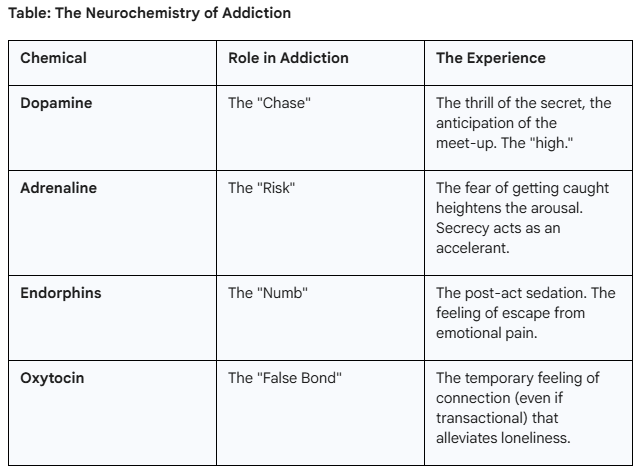
The Science of the Hook
Why the Brain Gets Hijacked
To truly understand why a man would risk a billion-dollar empire for a $500 encounter, we have to look at the neurobiology.
Dopamine is the master molecule of addiction. It is the molecule of more.
When an addict engages in the "ritual"—the hunt, the planning, the anticipation—the brain floods with dopamine. This creates a state of hyper-focus and trance.
- The Prefrontal Cortex (PFC): This is the "CEO" of the brain, responsible for logic, judgment, and impulse control.
- The Midbrain: This is the "Survivor," responsible for drive, hunger, and instinct.
In active addiction, the Midbrain hijacks the PFC. The logical part of the brain goes offline. This is why addicts often report feeling like they were "on autopilot" or "watching themselves from outside their body".6
Tiger described this perfectly: "I convinced myself that normal rules didn't apply." That is the voice of a hijacked brain.
The Crash (Withdrawal)
When the acting out stops (either through arrest, discovery, or exhaustion), the dopamine levels crash below baseline. This leads to:
- Anhedonia: The inability to feel pleasure.
- Irritability: "Dry drunk" syndrome.
- Depression.
- Anxiety.
This biological crash is what drives the addict back to the behavior. They aren't looking for fun anymore; they are looking to feel normal.
Collateral Damage — The Partner's Trauma
Elin and the "Three-Legged Stool"
We cannot talk about sex addiction without talking about the victims. In 2009, Elin Nordegren became the unwilling face of Betrayal Trauma.
For years, partners of sex addicts were treated as "co-dependents," implying they were somehow complicit in the addiction ("If she had been a better wife, he wouldn't have strayed"). This is false.
Modern treatment—including the model used at Prescott House—recognizes that the partner is a victim of psychological abuse and trauma.2
Gaslighting as Abuse
The most damaging part of sex addiction is not the sex; it is the lying. It is the Gaslighting.
- The Addict says: "You're crazy," "You're jealous," "She's just a waitress," "Nothing is going on."
- The Reality: The partner's intuition is screaming that something is wrong, but the addict systematically dismantles their trust in their own perception.
This creates a state of chronic anxiety and confusion in the partner. When the truth finally comes out (Discovery), it is a traumatic event comparable to PTSD. The partner's entire reality—their past, their memories, their trust—is shattered.
The Three-Legged Stool
Dr. Weiss, mentioned in the research, describes recovery as a "three-legged stool" 11:
- Leg 1: His Recovery. The addict getting sober, doing the 30 tasks, facing his demons.
- Leg 2: Her Recovery. The partner healing from the trauma, finding her own support, establishing boundaries.
- Leg 3: The Relationship Recovery. This is the last step. You cannot fix the marriage until the individuals are fixed.
In Tiger's case, the marriage did not survive. And that is a valid outcome. Recovery does not always mean "staying together." It means "getting healthy." Sometimes, the healthiest thing a partner can do is leave. The goal of treatment is to empower the partner to make that choice from a place of clarity, not chaos.
The Comeback Kid
Falling Down and Getting Up
The story of Tiger Woods didn't end in the clinic in Mississippi. His journey post-2009 was a jagged line of attempts, failures, and physical agony.
- The Physical Toll: The human body keeps the score. Tiger underwent multiple back surgeries, spinal fusions, and knee reconstructions. He lived in chronic, debilitating pain.
- The 2017 Rock Bottom: In May 2017, Tiger was found asleep at the wheel of his car, confused and slurring. He blew a 0.00 on the breathalyzer, but the toxicology report told a different story: Vicodin, Dilaudid, Xanax, Ambien, and THC.9
This moment revealed the Addiction Interaction Disorder in full force. He had swapped one numb for another. The sex addiction had morphed into a substance issue. It was a dark, humiliating moment—a mugshot that went viral, showing a bloated, heavy-lidded legend.
The 2019 Masters: Redemption
But then came April 2019.
Tiger Woods, fused spine and all, walked up the 18th fairway at Augusta National. He tapped in for bogey to win the Masters. He threw his arms up. He hugged his son, Charlie—a poignant echo of the hug he gave his own father in 1997.
Why did the world cry? Why did grown men weep in sports bars?
Because we love a comeback. But specifically, we love an imperfect comeback.
- Pre-2009 Tiger was a machine we admired but couldn't touch.
- Post-2019 Tiger was a human we related to.
He had been broken. He had been humiliated. He had been addicted. He had been arrested. And yet, he stood up.
This is the message we try to instill at Prescott House. Your addiction is not the end of your story. It is a chapter—a dark, messy, painful chapter—but it is not the whole book. If Tiger Woods can rebuild his life under the glare of the entire planet, you can rebuild yours.
The Silent Epidemic — Men's Mental Health
Why Men Don't Talk
Let’s zoom out. Tiger’s story is a high-profile example of a silent epidemic that kills thousands of men every year.
- 1 in 10 men experiences anxiety or depression, but less than half seek help.16
- Suicide rates are 4 times higher for men than women.16
- 40% of men won't talk to anyone about their mental health because they don't want to be a "burden" or appear "weak".17
Society tells men to "man up." It tells us to stuff our feelings down and perform. When we can't perform, or when the feelings get too big, we medicate.
- Some use bourbon.
- Some use betting apps (Sports Betting is a massive, growing addiction we treat).
- Some, like Tiger, use sex.
Toxic Masculinity and the "Lone Wolf" Myth
The idea that a man should handle his problems alone is dangerous. It is a lie.
Real strength is not suffering in silence. Real strength is looking at your life, realizing it’s off the rails, and raising your hand to say, "I need help."
Tiger’s apology was mocked, but the line "It's hard to admit that I need help, but I do" was perhaps the bravest thing he ever said. It was an admission of humanity.
Who We Are — The Prescott House Difference
"A Community That Understands"
So, why is Prescott House telling you all this? Because we are in the business of saving lives.
We are a long-term residential treatment center for men located in the beautiful, healing mountains of Prescott, Arizona. Since 1988, we have been helping men navigate the complex terrain of addiction—whether it's alcohol, drugs, gambling, or sex addiction.18
We are not a resort. We are a community.
Why Choose Prescott House?
You might be thinking, "Can't I just go to a 30-day detox and be done?"
Tiger Woods spent six weeks in inpatient care, followed by years of therapy. Recovery is not a microwave meal; it’s a slow-cooked feast.
1. Time to Heal (Extended Care)
The brain needs 3–6 months to recover functionality after addiction.20 A 30-day "spin-dry" often isn't enough to rewire the neural pathways of a sex addict who has spent decades acting out. We offer a 90–180+ day program. Why? Because we deal in sustainable recovery, not quick fixes. We want you to stay stopped.
2. A Band of Brothers
Isolation feeds addiction. Connection kills it.
Our program is gender-specific. There is a unique power in a group of men getting honest with each other. It cuts through the "macho" posturing. Men heal differently. We need accountability, we need challenge, and we need to know we aren't the only ones who have messed up. When you walk into Prescott House, you join a brotherhood of alumni who support each other for life.20
3. We Treat the Whole Man
We don't just take away the porn or the bottle. We look at the root causes.
- Trauma: We use EMDR (Eye Movement Desensitization and Reprocessing) and Somatic Experiencing to heal the wounds that drive the addiction.19
- The "Men's Intimacy Recovery" Track: This is our specialized program for sex addiction. It uses the CSAT model and the 30 Tasks to help men rebuild healthy sexuality.18
- Equine Connection: Horses don't lie. They mirror your energy. Working with horses teaches men mindfulness, boundary setting, and emotional regulation in a way that talk therapy sometimes can't.18
- Fun: Yes, fun! We believe recovery should be enjoyed. We do adventure therapy, sports, and community integration. You can’t stay sober if your life is boring.
4. The "Gentle Path" Influence
We are proud to utilize the methodologies championed by leaders in the field like Dr. Carnes. We understand the nuances of:
- Pornography Addiction
- Love Addiction
- Intimacy Disorders
"You're Not Alone"
The biggest lie addiction tells you is that you are unique in your brokenness.
- "No one has done what I've done."
- "No one has thought the things I've thought."
- "If they knew the truth, they would leave."
Tiger Woods probably thought that. And when the truth came out, he lost a lot—but he also gained his life back. He gained the ability to look his children in the eye. He gained a level of authenticity he never had when he was hiding.
At Prescott House, we see miracles every day. We see men who have lost their families, their jobs, and their self-respect walk through our doors. And slowly—task by task, group by group, brick by brick—they rebuild a life that is better, richer, and more honest than the one they left behind.
Conclusion: The Final Scorecard
Tiger Woods is a legend. But not just because he won 15 majors. He is a legend because he fell from the highest height, hit the hardest ground, and decided to get back up.
Sex addiction is not a moral failing. It is not a sign that you are a "bad person." It is an intimacy disorder. It is a coping mechanism that has stopped working and started destroying. It is treatable.
If you are reading this and you see yourself in the shadows of Tiger’s story—if you are living a double life, if you are terrified of being found out, if you feel out of control—know this:
You don't have to live that way anymore.
There is a way out of the basement. There is a path to a life where you don't have to hide your phone, delete your browser history, or look over your shoulder. A life where you can look in the mirror and like what you see.
At Prescott House, we know the way. We’ve walked it ourselves, and we’ve walked it with thousands of men just like you.
We are here. We are ready. The first step is yours.
Call us. Let’s get you back on the course.
(Note: This article is intended for educational purposes and to spread awareness. If you or a loved one are struggling, professional help is the only way to ensure safety and recovery.)
Extended Deep Dive: Clinical & Cultural Analysis
10. The "Tiger Effect" on Addiction Awareness
Before 2009, "sex addiction" was largely seen as a joke or a myth. Tiger Woods changed that. He forced a global conversation about the nature of intimacy disorders.
- The Medicalization of Morality: Critics argued that calling it an addiction excused the behavior.
- The Clinical Rebuttal: Addiction explains the cause, it does not excuse the action. Recovery is about taking radical responsibility. The 30-Task model specifically includes "Restitution" and "Amends." You cannot recover without owning your wreckage.
11. The Role of the Enabler
Tiger didn't act alone. He had a network.
- The Bubble: High-profile addicts often have "handlers" whose job is to keep the addict happy and functioning.
- Collusion: Friends, employees, or VIP hosts who facilitate the behavior are "colluding" with the disease.
- Treatment: Part of recovery is firing the enablers. You have to clean house. You have to surround yourself with people who will tell you "No."
12. "Somatic" Healing
Why do we use horses and yoga at Prescott House?
Because trauma lives in the body.
- The Body Keeps the Score: Men often "dissociate" from their bodies. They treat their body like a tool or a machine (just like Tiger did).
- Re-connection: Yoga, meditation, and Equine therapy help men get back into their bodies. They learn to feel an emotion without acting on it. They learn to sit with discomfort. This is a critical skill for preventing relapse.
13. The Future of Recovery
The Tiger Woods story teaches us that recovery is a lifelong process. It is not a destination.
- Maintenance: It requires ongoing work. 12-Step meetings. Sponsorship. Service.
- Vigilance: The addict must always be aware of the "Secret Basement" trying to reopen.
- Hope: The ultimate message is hope. No matter how far down the scale you have gone, you can come back. You can find peace.
Prescott House is here to help you find that peace.
Works cited
- Tiger Woods' Sex Scandal: Inside His Fall From Grace and Comeback - Biography, accessed December 16, 2025, https://www.biography.com/athletes/tiger-woods-sex-scandal-facts
- Deceptive Sexuality & Trauma Resource Library - Minwalla Model, accessed December 16, 2025, https://minwallamodel.com/resource-library/
- Crisis Management and Sports in the Age of Social Media: A Case Study Analysis of the Tiger Woods Scandal - Inquiries Journal, accessed December 16, 2025, http://www.inquiriesjournal.com/articles/833/2/crisis-management-and-sports-in-the-age-of-social-media-a-case-study-analysis-of-the-tiger-woods-scandal
- Let´s talk about the betrayer and what is happening for him! |, accessed December 16, 2025, https://enrichingyourrelationship.com/blog/lets-talk-about-the-betrayer-and-what-is-happening-for-him/
- BAD BOYS: SEXUAL ADDICTION OR ENTITLEMENT? SHARON O'HARA, LMFT, C-SAT, accessed December 16, 2025, https://ongoodauthority.com/content/Bad_Boys/BAD%20BOYS%20PDF.pdf
- Compulsive sexual behavior - Symptoms and causes - Mayo Clinic, accessed December 16, 2025, https://www.mayoclinic.org/diseases-conditions/compulsive-sexual-behavior/symptoms-causes/syc-20360434
- What Distinguishes Sex Addiction From Naturally High Sex Drives? - The Right Step, accessed December 16, 2025, https://www.rightstep.com/rehab-blog/what-distinguishes-sex-addiction-from-a-naturally-high-sex-drive/
- Author: I Know for Fact Tiger in Sex Rehab - CBS News, accessed December 16, 2025, https://www.cbsnews.com/news/author-i-know-for-fact-tiger-in-sex-rehab/
- From Substance Abuse Treatment To The Golf Course – How Tiger Woods Is Holding Up After Rehab | Northpoint Seattle, accessed December 16, 2025, https://www.northpointseattle.com/blog/substance-abuse-treatment-golf-course-tiger-woods-holding-rehab/
- Notes From a Scandal: What Tiger Teaches - Comment Magazine, accessed December 16, 2025, https://comment.org/notes-from-a-scandal-what-tiger-teaches/
- What Happens in Sex Rehab? - Time Magazine, accessed December 16, 2025, https://time.com/archive/6934109/what-happens-in-sex-rehab/
- Our Board of Directors - American Foundation for Addiction Research -, accessed December 16, 2025, https://addictionresearch.com/about/board/
- Patrick Carnes 30 Tasks - Susan Zola, accessed December 16, 2025, https://susanzola.com/patrick-carnes-30-tasks/
- Recovery With the 30-Task Model | Gentle Path at The Meadows, accessed December 16, 2025, https://gentlepathmeadows.com/recovery-with-the-30-task-model/
- VIDEO: Therapist: Tiger's Sexual Addiction 'Lifelong Struggle' - YouTube, accessed December 16, 2025, https://www.youtube.com/watch?v=kW7LttLfAcQ
- Men's Health Awareness and Mental Health | American Addiction Centers, accessed December 16, 2025, https://americanaddictioncenters.org/blog/mens-health-awareness-and-mental-health
- Men's Mental Health: Why 40% of men won't talk about it - Priory, accessed December 16, 2025, https://www.priorygroup.com/blog/40-of-men-wont-talk-to-anyone-about-their-mental-health
- Prescott House, accessed December 16, 2025, https://www.prescotthouse.com/
- Prescott House: Insurance, Reviews, Testimonials (Prescott, Arizona) - Recovery.com, accessed December 16, 2025, https://recovery.com/prescott-house-prescott-arizona/
More Celebrity Stories You Might Find Inspiring
- That 70’s Show Star Lisa Robin Kelly Dies Suddenly in Rehab
- Lady Gaga and Her Struggles with Drug Abuse
- Beyond Justin Baldoni's Sex Addiction Discussion: Understanding and Finding Help for Compulsive Sexual BehaviorsIntroduction
- Darren Waller Drugs: Overcoming Addiction and Finding Hope in Recovery
- Lil Wayne and Lean: Understanding the Risks of Purple Drank Addiction
- The 27 Club: Exploring the Reality of Legendary Loss
- Learning from Tragedy: Understanding Addiction in the Wake of Heath Ledger's Fatal Addiction
- Wendy Williams’ Struggles with Drug Addiction: What Happened and Why It Matters
- Reese Witherspoon Jailed for Interfering With her Husband’s DUI Arrest
- Demi Lovato's Overose and Near-Death
- Remembering Kurt Cobain
- Ben Affleck Gambling: Understanding Gambling Addiction and the Path to Recovery
- The Tragic Overdose of Kris Kross's Chris Kelly: A Look Back at a Life 'Totally Krossed Out'
At Prescott House, Recovery Becomes Reality
Tiger Woods’ story reveals the devastating reality of the "secret life," but serves as a powerful reminder that recovery from Compulsive-Entitled Sexuality is possible—even after a total collapse. At Prescott House in Prescott, Arizona, we provide the long-term, structured environment men need to heal from intimacy disorders and rebuild their integrity from the ground up. Explore our specialized programs:
- Long-Term Addiction Treatment for Men — Structured healing and accountability for lasting recovery.
- Substance Abuse Treatment — A full continuum of care for alcohol and drug dependence.
- Gambling Addiction Treatment — Break the cycle of financial and emotional strain.
- Sex & Process Addiction Programs — Compassionate support for compulsive behaviors.
- Dual Diagnosis Treatment — Integrated care for mental health and substance use disorders.
Learn More About Our Program →