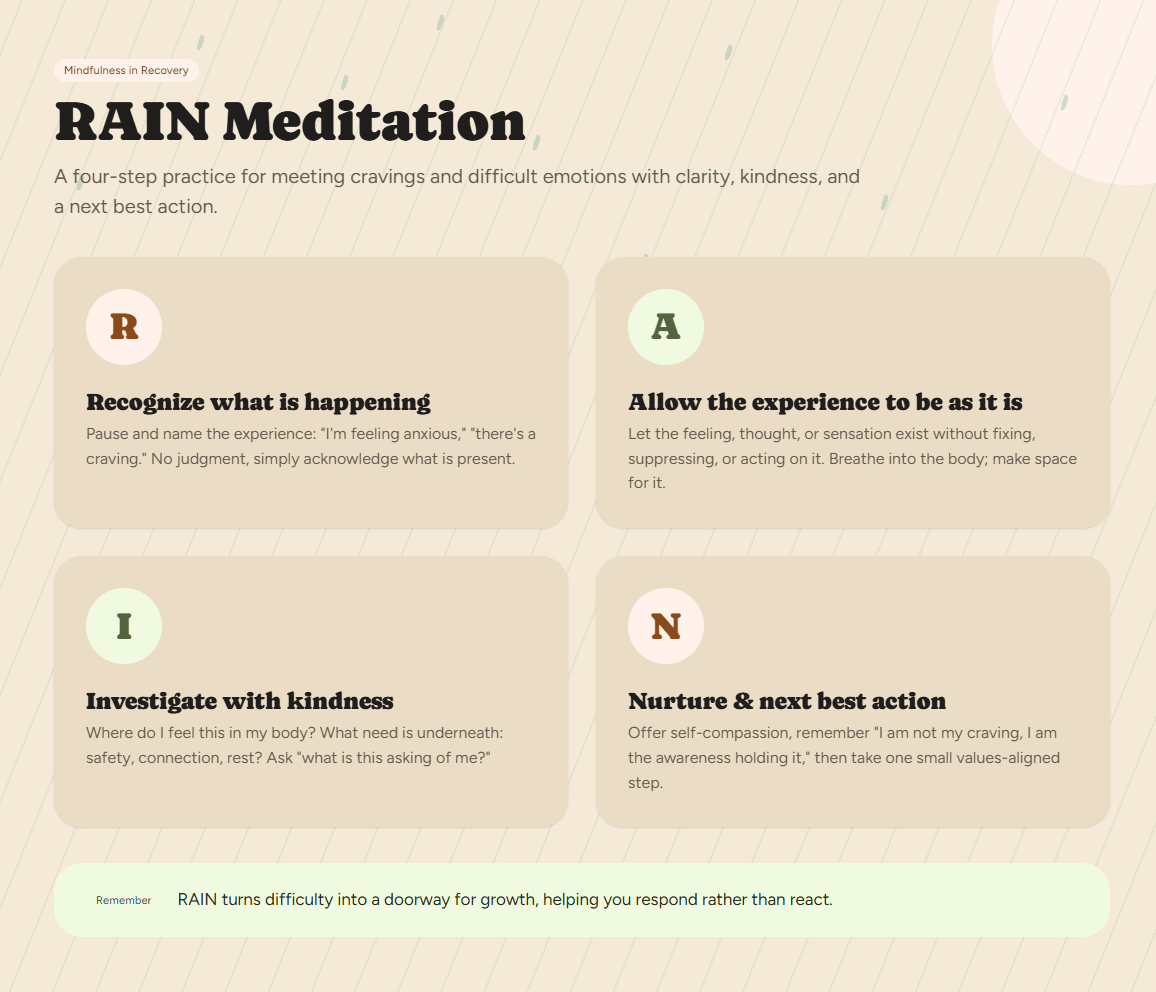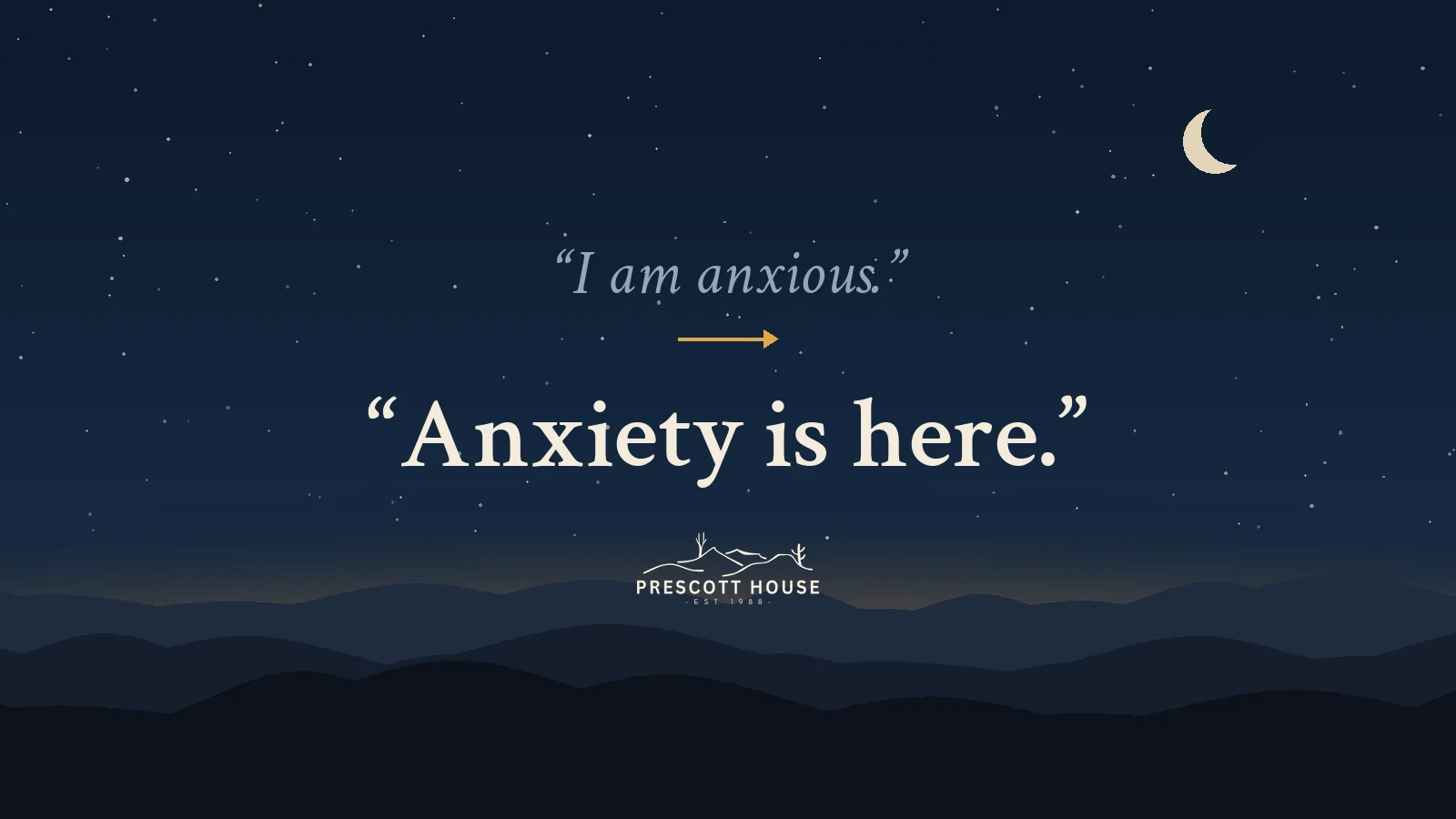
Recovery does not take away anxiety, anger, shame, or urges. What changes is how a man relates to them. A small shift in the words he uses with himself can open up room to choose what happens next.
Recovery does not remove disappointment, uncertainty, grief, anger, boredom, or loneliness. Anyone who promises otherwise is selling something. What recovery can change is the relationship a man has with those experiences, so that a hard feeling no longer gets to make every decision for him.
The purpose is not to make life painless. It is to reduce the suffering we add on top of the pain.
"Something Happened, and I Reacted"
Most of us know the sequence. A difficult interaction leads to tension and hurt. Then comes the thought, "I need relief," then an urge, then the familiar reaction that has always delivered that relief, at least for a little while.
Without awareness, all of that feels like one single event. Something happened, and I reacted. There seems to be no space in the middle.
Mindfulness invites a closer look at that middle. What is my experience of this moment? My chest is tight. I feel rejected. My mind is telling me nobody cares. I want to escape this feeling. And then a different kind of question: what would support me right now?
The important discovery is not simply that a pattern exists. It is that the pattern is made of pieces we can learn to recognize, and that there are moments inside it when a different response becomes possible. (We go deeper into how that automatic loop forms in From Autopilot to Awareness.)
The Language Shift
One of the simplest places to start is with the words we use inside our own heads. Compare these familiar reactions with a different way of saying the same thing:
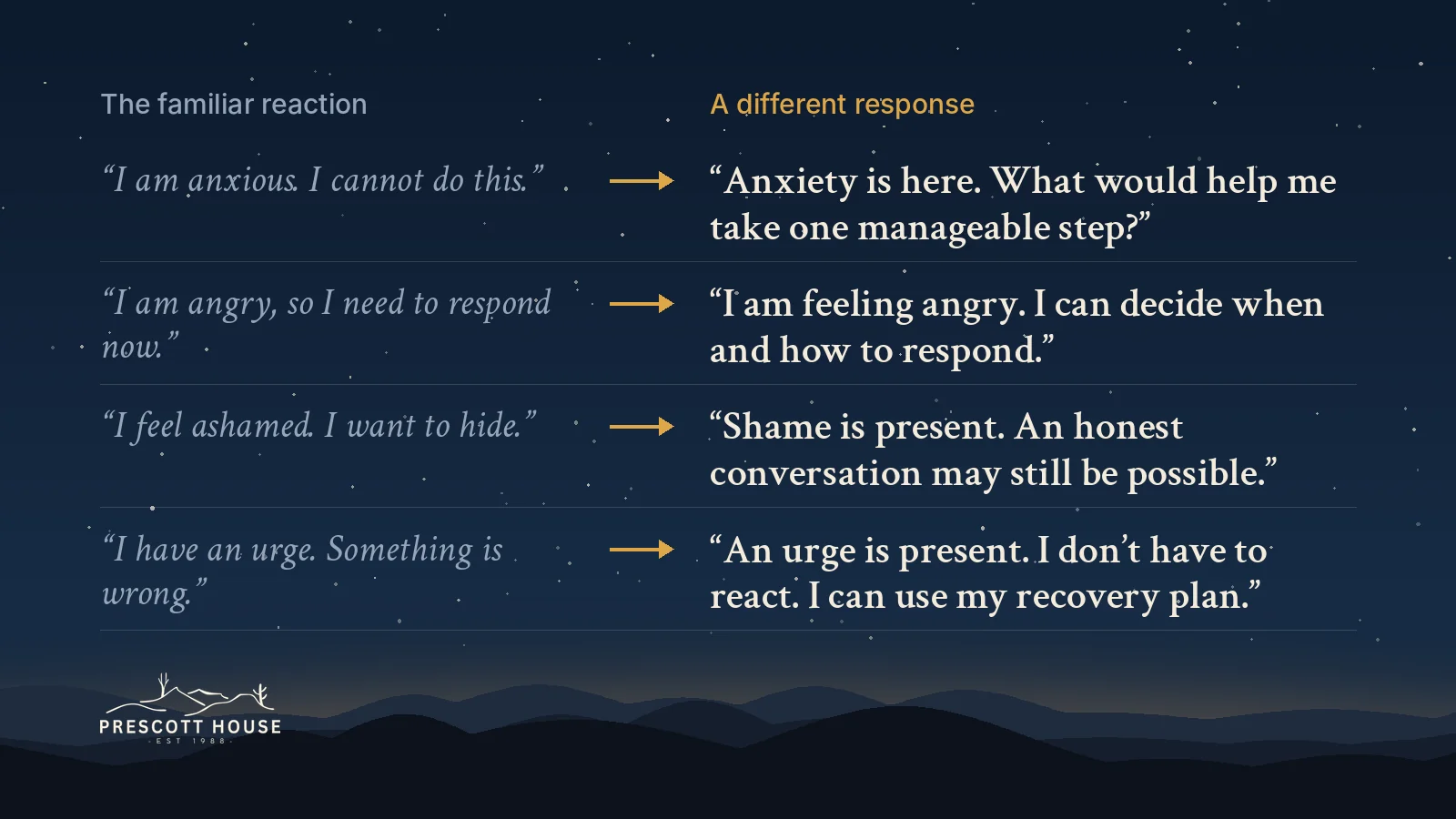
- "I am anxious. I cannot do this." becomes "Anxiety is here. What support would help me take one manageable step?"
- "I am angry, so I need to respond now." becomes "I am feeling angry. I can decide when and how to respond."
- "I feel ashamed. I want to hide." becomes "Shame is present. An honest conversation may still be possible."
- "I have an urge. Something is wrong." becomes "An urge is present. Cravings and urges are normal. I do not have to react. I can notice it and use my recovery plan."
Notice what changes. In the first version, the feeling is the man. "I am anxious" leaves no room for anything else. In the second, the feeling is something passing through him. It is real, and it is here, and he is still the one deciding what to do.
This is not toxic positivity or repeating affirmations until you feel better. These phrases are not scripts that must make anyone feel better immediately. They are a more honest description of what is actually happening, and that honesty is what opens up a more discerning choice.
In acceptance-based approaches like Acceptance and Commitment Therapy (ACT), this is called psychological flexibility: staying connected to the present, making room for difficult internal experiences, and acting in line with your values even while discomfort remains. Acceptance here is not liking something, and it is not condoning it. It is seeing clearly what is here, now, from a less reactive place.
The question shifts from "How do I get rid of this feeling?" to "What am I feeling, what do I need, and what action would serve me?"
A Problem Is Not an Identity
Mindfulness does not require pretending nothing is wrong. Loss, injustice, illness, conflict, and practical hardship are real. The distinction is between acknowledging a problem and letting that problem, or the mind's story about it, become the whole definition of who we are.
Compare:
- "Something painful happened." with "My life is nothing but pain."
- "I made a harmful choice." with "I am a hopeless person."
The first statement names something that can be felt, understood, or addressed. The second turns an experience into an identity, and an identity is much harder to work with. A man who believes he is hopeless has very little reason to try the next right thing.
ACT calls the skill here defusion: recognizing thoughts as thoughts rather than automatically treating them as facts or commands. It does not require proving every difficult thought false. A useful phrase is simply, "I am noticing the thought that nothing will ever change." That wording does not solve the situation. It creates just enough distance to ask, "What is actually happening, and what remains possible?"
Courage Doesn't Mean Feeling Calm
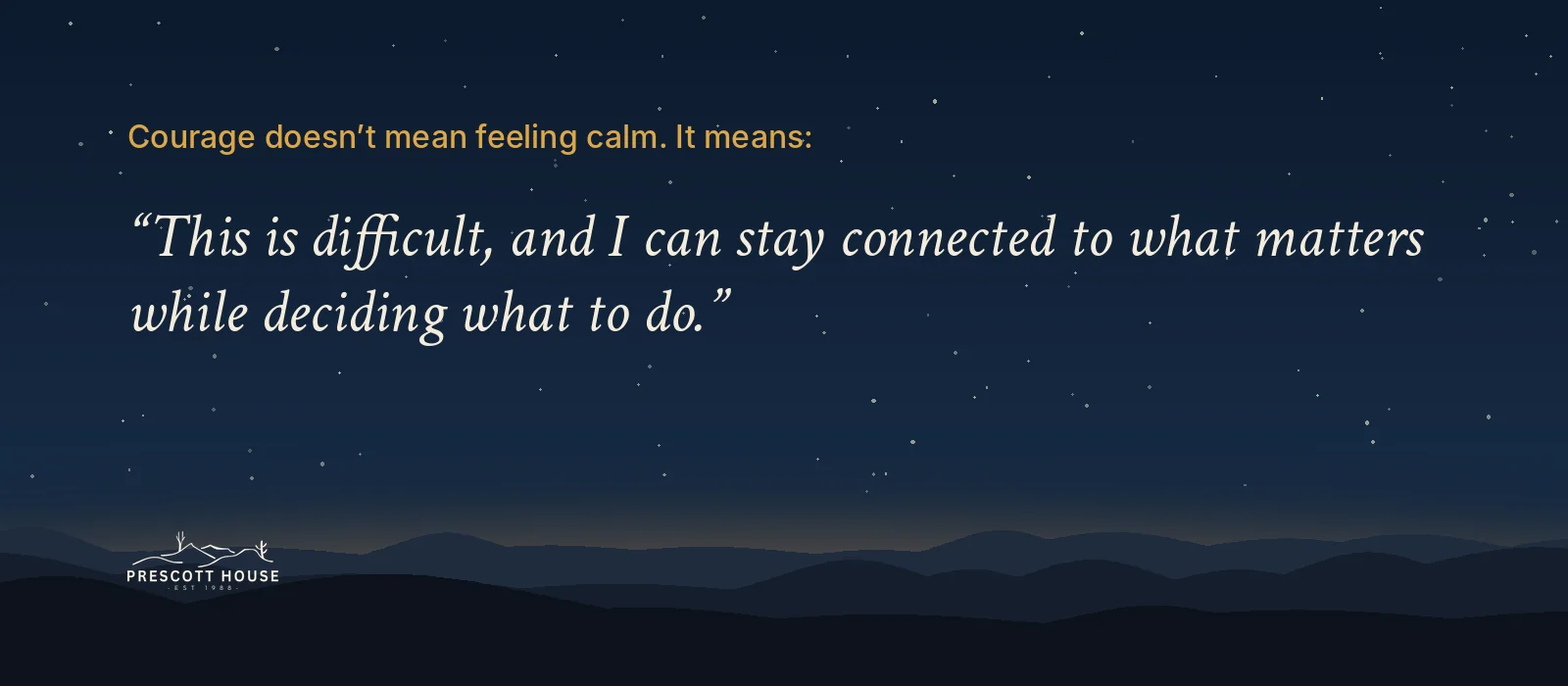
For a lot of men, courage has meant toughing it out, keeping it together, and handling things alone. In recovery, courage means something different. It does not mean feeling calm, enduring everything by yourself, or staying in a situation that is harming you.
It means practicing this possibility: "This is difficult, and I can stay connected to what matters while deciding what to do."
In real life that might look like:
- Feeling embarrassed and asking for help anyway.
- Feeling guilty and still holding an appropriate boundary.
- Feeling grief and letting someone keep you company in it.
- Feeling an urge and moving away from access to substances.
- Feeling uncertain and taking one carefully chosen step.
The strength being built is flexibility, not emotional invulnerability. Willingness to feel discomfort is there to serve a life you care about. It is not a demand to tolerate pain for its own sake.
Sometimes the courageous response is to stay present. Sometimes it is to leave, rest, seek protection, or get professional help.
When You Only Notice Afterward
Nobody catches every moment. Sometimes a man only realizes after the fact that he was withdrawing from the people who support him, rehearsing the same resentment over and over, romanticizing the relief and leaving out the consequences, or quietly overwhelmed and no longer asking for help.
Noticing late still counts. The practical value lies in what follows: "Because I notice this, I can contact someone, leave this situation, revisit my plan, or address what I have been neglecting." Mindful awareness is not passive observation. It can lead directly to protective action.
The question becomes, "If I noticed only afterward, what can I do now?" The next step may be repair, reconnection, or a more realistic plan. It is not self-punishment. A lapse or a return to use does not prove someone has failed, or that they lack courage. Awareness is one resource within recovery, not control over every influence on behavior.
What Am I Choosing to Participate In?
A recovery practice can be about more than watching for danger. Mindful attention can also be brought, on purpose, to connection, enjoyment, meaningful activity, and the actions that express who a man wants to be.
This is the values side of the practice. Not only "What am I trying to stop?" but "What am I choosing to participate in?" In ACT, values are not achievements you have to complete before life can start. They are qualities of action you can express moment by moment, starting today.
Everyday invitations might include:
- Listening to someone without preparing your reply.
- Noticing enjoyment without immediately looking for something more.
- Recognizing that you kept a promise to yourself.
- Allowing a pleasant moment to matter, even when other problems remain.
- Asking, "What would care, honesty, or courage look like here?"
The goal is not constant gratitude or positivity. It is fuller participation in life, including the parts that are difficult and ordinary as well as the good ones. At a time of year when many families gather and many men feel the gap between how things are and how they think things should be, letting a good moment count, even a small one, is a skill worth practicing.
How This Fits at Prescott House
Mindfulness is not the only foundation of recovery, and you do not have to call it mindfulness to build these skills. At Prescott House it works alongside other parts of care: individual and group therapy, medication when indicated, supportive relationships, and a practical recovery plan. Our intention is to bring many modalities of care to the men we work with, and to give them a safe place to explore and discover a greater sense of meaning in their lives.
Time matters here too. A new way of talking to yourself does not stick after one good conversation. It takes repetition, on ordinary days and hard ones, with people around who will notice and remind you. That is part of why our program is built for the long term.
A Closing Word
Learning to cultivate this kind of awareness is not about becoming someone who never struggles. It is about acknowledging pain without making pain your entire identity, feeling an urge without treating it as an instruction, and asking for help without first having everything figured out.
It is becoming more able to notice, respond, reconnect, and begin again, while continuing to build a life that matters. Researcher Brené Brown describes integrity as choosing courage over comfort. In recovery, that choice gets made in small moments, one honest sentence at a time.
If you or a loved one would like to learn more about how mindfulness is part of recovery at Prescott House, you can contact our admissions team or learn more about our long-term program for men.
About the Author

Marsha J. Gehl, CMT-P is the Meditation and Mindfulness Teacher at Prescott House. A Doctor of Chiropractic with more than thirty years in healthcare, Marsha made a deliberate transition into mindfulness and meditation education, bringing with her a deep understanding of the nervous system, the body's response to stress, and how unresolved pain, whether physical or emotional, shows up in people's lives.
Marsha holds the Certified Mindfulness Teacher, Professional (CMT-P) credential from the International Mindfulness Teachers Association (IMTA), independently verifiable through the IMTA Certified Teacher Directory. Her training also includes the Mindfulness Meditation Teachers Certification Program (MMTCP) through UC Berkeley's Greater Good Science Center, Trauma-Sensitive Mindfulness with David Treleaven, PhD, Mindfulness-Based Stress Reduction (MBSR), Mindfulness-based Mind Fitness Training (MMFT) with Elizabeth Stanley, PhD, and Nonviolent Communication training with Oren Jay Sofer.
She has worked extensively with people in addiction recovery and has been part of the Prescott House team since 2022. Read Marsha's full bio
Keep Reading
From Autopilot to Awareness: Mindfulness as an Antidote to Addiction. The habit loop behind addiction, the RAIN practice, and urge surfing.
Mindfulness, Narrative, and the Long Road to Recovery. Why rewriting the story you tell about yourself is real therapeutic work, and why it takes time.
Mindfulness-Based Relapse Prevention: A Compassionate Path Through Recovery. The eight-week MBRP model and the research behind it.
Sources and Further Reading
- Association for Contextual Behavioral Science. The Six Core Processes of ACT. https://contextualscience.org/six_core_processes_act
- Priddy, S. E., Howard, M. O., Hanley, A. W., Riquino, M. R., Friberg-Felsted, K., & Garland, E. L. (2018). Mindfulness meditation in the treatment of substance use disorders and preventing future relapse: neurocognitive mechanisms and clinical implications. Substance Abuse and Rehabilitation, 9, 103–114. https://pmc.ncbi.nlm.nih.gov/articles/PMC6247953/
- Recovery Research Institute. Relapse Prevention (RP). https://www.recoveryanswers.org/resource/relapse-prevention-rp/
This article is for educational purposes and is not a substitute for professional medical or mental health care. If you are struggling with substance use, please reach out to a qualified clinician or call SAMHSA's National Helpline at 1-800-662-HELP (4357).
Recovery that lasts takes time
Prescott House gives men 90 days or more, a recovery community, and a real practice run at life before they go home.