Addiction is often described as a disorder of compulsion, but that description is incomplete. It is also a disorder of attention, of meaning, of identity, and of a person's relationship to their own suffering. The man in recovery is not only trying to stop a behavior. He is trying to build a life that feels worth living. That distinction is where mindfulness becomes far more than a wellness trend.
The Pause Between Impulse and Action
Mindfulness-based interventions are structured, evidence-based therapeutic programs that bring secular mindfulness practices, such as meditation and body awareness, into psychological treatment. They help people observe their thoughts and physical sensations without judgment, which in turn supports emotional regulation, stress reduction, and overall mental health.
In recovery, that skill does something specific. It helps a person notice craving, fear, shame, boredom, and distress without being immediately pulled into the old reflex to escape. It creates a small but life-changing pause between impulse and action. And in that pause, choice becomes possible.
This is why mindfulness fits so naturally into so many therapeutic models. Cognitive Behavioral Therapy uses it to interrupt automatic thinking. Acceptance and Commitment Therapy uses it to increase psychological flexibility. Dialectical Behavior Therapy uses it to stabilize emotion and tolerate distress. Trauma-informed care uses it to reconnect people to the present moment without overwhelm. Mindfulness is not a rival theory competing with these approaches. It is a process skill that strengthens the effectiveness of all of them.
For a closer look at how this works as a structured, eight-week practice, our companion piece, Mindfulness-Based Relapse Prevention: A Compassionate Path Through Recovery, walks through the model in detail.
Recovery Is Also a Matter of Self-Concept
Self-regulation is only half of the work. Recovery is also about self-concept.
Many people who struggle with addiction have lived for years under a dominant story that says they are broken, dangerous, weak, or permanently damaged. That story does real harm, and rewriting it can itself be therapeutic. When someone begins to narrate their own life through the lens of survival, learning, responsibility, and repair, they are not denying the harm they caused or experienced. They are refusing to let that harm be the only true thing about them.
Narrative work matters because people tend to live out the identities they can bear to hold. A man who believes he is nothing but his worst moments has very little to protect when the next craving arrives. A man who has begun to see himself as someone capable of growth and repair has a reason to stay. The story is not decoration. It is structural.
Flourishing Is Part of the Work, Not a Reward for Finishing It
Recent recovery research increasingly points in the same direction: flourishing matters, and it matters earlier than we used to assume. Serenity, confidence, positive emotion, and a felt sense of growth are not luxuries to be added once the real work is done. They are part of the real work.
People do better when recovery becomes a lived developmental process rather than a narrow absence of use. The goal is not simply to remove the substance and leave a hollow space where it used to be. The goal is to help a person build a fuller, more connected, more meaningful life, because that fuller life is what makes the absence of the substance sustainable. This is the same whole-person logic behind everything we do, which we explore further in More Than Willpower: A Whole-Person Approach to Addiction Recovery.
Why Time and Structure Matter
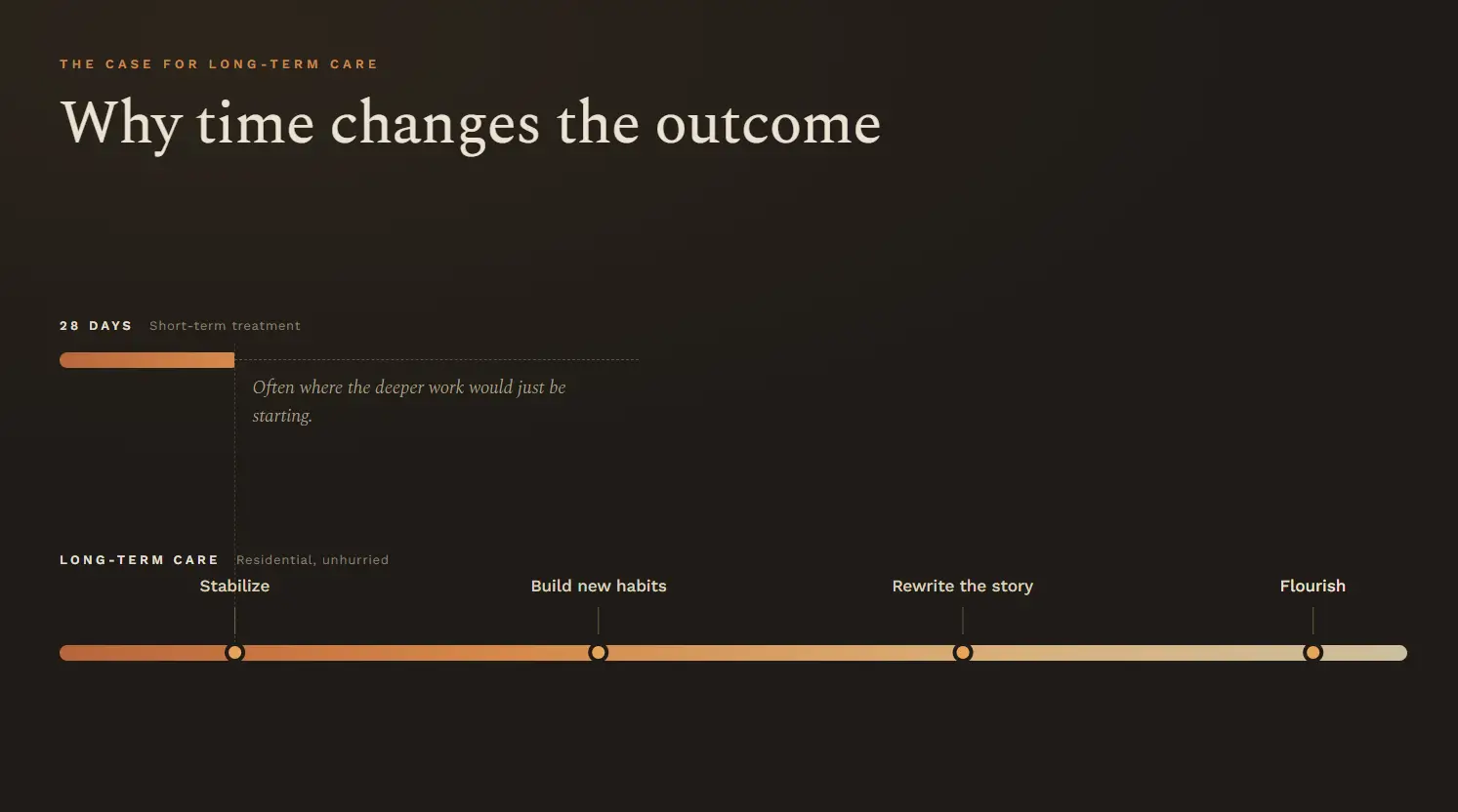
For some people, especially those facing severe, chronic, or socially entangled addiction, a long-term residential program or therapeutic community provides the container this work requires. The evidence suggests that longer engagement is often associated with better outcomes, including sustained abstinence and improved psychosocial functioning.
Residential treatment is not magical, and length alone is not enough. A person can spend months somewhere and change very little if the conditions are wrong. But for people who need structure, safety, repetition, and relational repair, a long-term setting can create the conditions where identity change actually takes root. It gives mindfulness time to become a habit rather than a concept. It gives the new story time to be lived rather than just spoken. And it gives flourishing time to feel real.
The men we work with did not arrive at addiction overnight, and the deeper changes recovery asks of them rarely happen on a four-week schedule. That is much of the reason our model is built the way it is, a point we make in Treating the Trauma Underneath Addiction, where the same need for time shapes how trauma is treated.
Building a Self That No Longer Needs Relapse
Here is the provocative heart of it. Recovery is not only about resisting relapse. It is about building a self that no longer needs relapse in the first place.
Mindfulness helps with the first task, the moment-to-moment work of meeting an urge without obeying it. Narrative and relationship help with the second, the slower work of becoming someone for whom the old escape no longer fits. And long-term therapeutic environments give both of those processes enough time to matter.
The strongest themes in the recent literature line up cleanly with what we see every day: mindfulness as a relapse-prevention mechanism, flourishing as a meaningful recovery outcome in its own right, and identity reconstruction as a genuine therapeutic target. Long-term residential care appears most useful precisely when it is sustained, structured, and matched to the severity and complexity of the person in front of you, rather than treated as a one-size-fits-all fix.
That is the work. Not just stopping, but becoming. And it is some of the most hopeful work there is.
Frequently Asked Questions
Is mindfulness a replacement for therapy?
No. Mindfulness is a process skill that strengthens other approaches rather than competing with them. It works alongside Cognitive Behavioral Therapy, trauma-focused care, and the other modalities in a treatment plan, helping a person apply those tools in the moments that matter most.
What does "narrative" or "identity" work mean in recovery?
It refers to the gradual process of rewriting the story a person tells about who they are. Many people in addiction carry a story of being broken or beyond help. Learning to see oneself as capable of growth, responsibility, and repair is not denial of past harm. It is a therapeutic shift that gives a person something worth protecting in recovery.
Why does long-term treatment make a difference?
Deep change in attention, identity, and relationships rarely happens quickly. Longer engagement gives mindfulness time to become a habit, gives a new sense of self time to be lived rather than just discussed, and is associated in the research with better long-term outcomes for people facing severe or chronic addiction.
About the Author
Marsha J. Gehl, CMT-P is the Meditation and Mindfulness Teacher at Prescott House. A Doctor of Chiropractic with more than thirty years in healthcare, Marsha made a deliberate transition into mindfulness and meditation education, bringing with her a deep understanding of the nervous system, the body's response to stress, and how unresolved pain, whether physical or emotional, shows up in people's lives. She holds the Certified Mindfulness Teacher – Professional (CMT-P) credential from the International Mindfulness Teachers Association (IMTA), and has worked extensively with people in addiction recovery. Read Marsha's full bio.
Keep Reading
- Mindfulness-Based Relapse Prevention: A Compassionate Path Through Recovery. A deeper dive into the eight-week MBRP model and the research behind one of the most evidence-supported contemplative approaches in addiction care.
- More Than Willpower: A Whole-Person Approach to Addiction Recovery. The whole-person model behind treatment at Prescott House, and how mindfulness fits alongside CBT, EMDR, and experiential therapies.
- Treating the Trauma Underneath Addiction. Why trauma and addiction have to be treated together, and why that work takes longer than thirty days.
Sources and Further Reading
- Moniz-Lewis, D. I. K. (2024). The mindful resiliency in recovery model: empowering the transcendence of stigma. Frontiers in Psychology, 15. https://www.frontiersin.org/journals/psychology/articles/10.3389/fpsyg.2024.1460329/full
- Mindfulness-based interventions for the treatment of substance and behavioral addictions: a systematic review. PMC. https://pmc.ncbi.nlm.nih.gov/articles/PMC5884944/
- Effectiveness of mindfulness-based relapse prevention in individuals with substance use disorders: a systematic review. PMC. https://pmc.ncbi.nlm.nih.gov/articles/PMC8533446/
- Witkiewitz, K., et al. Mindfulness-based treatment to prevent addictive behavior relapse: theoretical models and hypothesized mechanisms of change. PMC. https://pmc.ncbi.nlm.nih.gov/articles/PMC5441879/
Watch: In this webinar, Dr. Neha Chawla, one of the three co-creators of Mindfulness-Based Relapse Prevention, walks through the thinking behind the approach. A worthwhile listen if you want to hear the framework explained by someone who helped build it.
This article is for educational purposes and is not a substitute for professional medical or mental health care. If you or someone you love is struggling with substance use, please reach out to a qualified clinician or call SAMHSA's National Helpline at 1-800-662-HELP (4357).
Talk With Us
If this resonated and you are trying to understand what long-term, whole-person recovery could look like for someone you love, our admissions team is here to talk it through. Contact us whenever you are ready, before you have decided anything at all.