Every June, treatment centers post about PTSD Awareness Month. Most of it says the same thing: trauma is real, healing is possible, reach out. All true. None of it especially useful to the clinicians and referral partners who already know trauma is real because they sit across from it every week.
So this year we want to say something more specific. In our experience, and in the research, post-traumatic stress is one of the most common forces underneath addiction, and one of the most common reasons short-term treatment does not hold. That is the conversation worth having this month.
What PTSD Actually Looks Like in This Population
Post-traumatic stress disorder is defined in the DSM-5 by four symptom clusters: intrusion (unwanted memories, nightmares, flashbacks), avoidance of reminders, negative changes in mood and cognition, and changes in arousal and reactivity such as hypervigilance, irritability, and sleep disturbance.
In men, that last cluster often dominates the clinical picture. Instead of presenting as fear or flashbacks, post-traumatic stress in men frequently shows up as anger, risk-taking, emotional shutdown, and substance use. Men are also less likely than women to seek mental health care in the first place, which means the trauma often goes unnamed until something else, usually the addiction, forces the issue. By the time a man reaches treatment, the PTSD may have been driving the bus for years without ever appearing on an intake form.
How Often Trauma and Addiction Travel Together
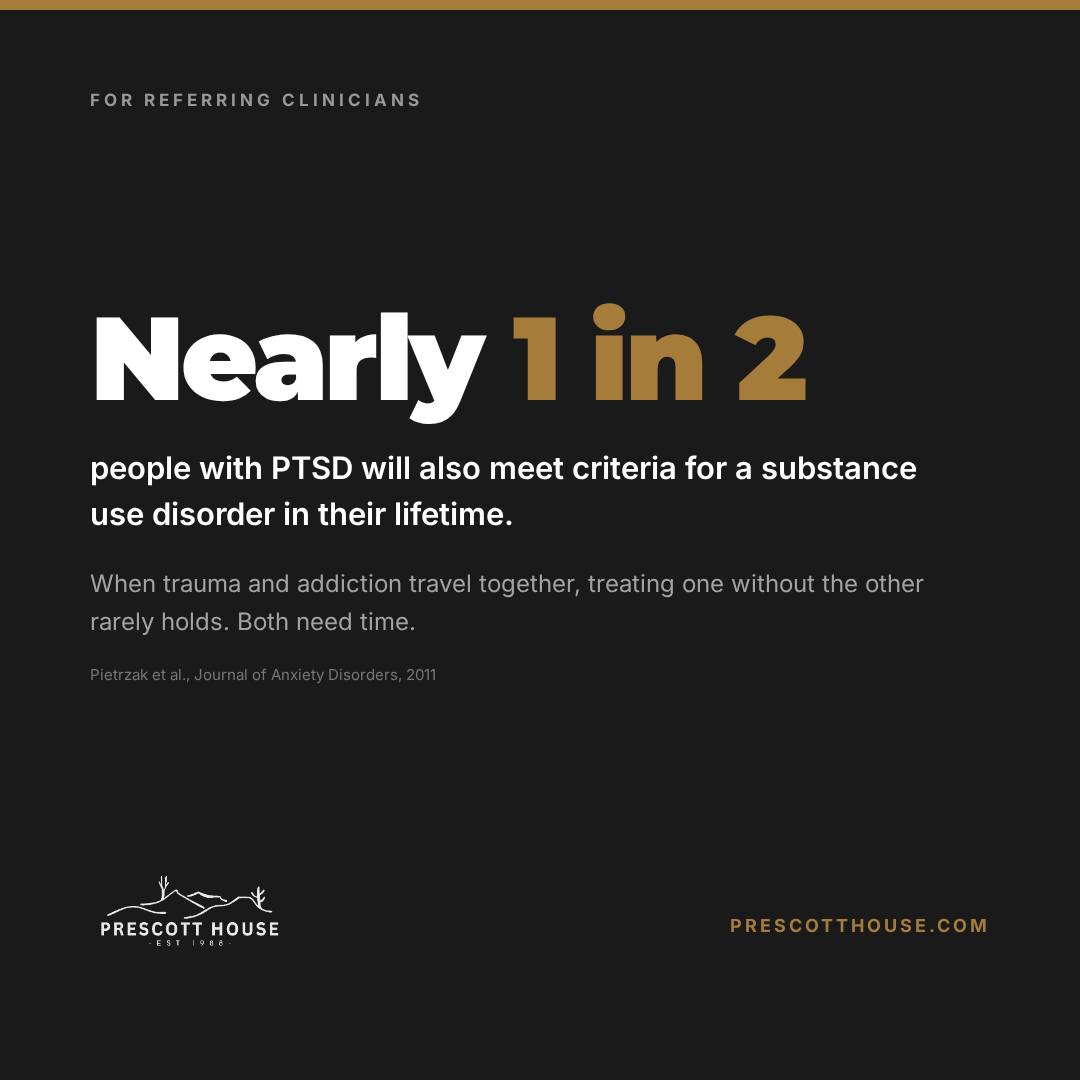
The comorbidity numbers are hard to ignore. In a nationally representative U.S. sample, 46.4 percent of individuals with lifetime PTSD also met criteria for a substance use disorder (Pietrzak et al., 2011). Roughly 6 percent of U.S. adults will experience PTSD in their lifetime (National Center for PTSD), and rates among people already in addiction treatment run several times higher than in the general population.
The relationship runs in both directions. Substances offer fast, reliable, short-term relief from intrusion and hyperarousal symptoms. That is the self-medication hypothesis Khantzian described decades ago, and it remains one of the most clinically useful frames for this population. The relief works, briefly, which is exactly why it becomes a pattern. Avoidance maintains the PTSD, the PTSD maintains the drinking or the using, and each cycle deepens the other.
Process Addictions Belong in This Conversation
The same cycle drives behaviors that never involve a substance. Gambling, sex, and love addiction offer the same things alcohol does: escape, numbing, a reliable change in state. Research consistently finds elevated rates of trauma exposure and post-traumatic symptoms among people with gambling disorder and compulsive sexual behavior.
These are also the cases that most often get referred out, because few programs treat process addictions as primary conditions rather than footnotes. When a client keeps cycling through short stays for the visible problem while the trauma and the process addiction stay untouched, the pattern tends to repeat. We built our program around exactly these cases.
Why 30 Days Rarely Touches Trauma
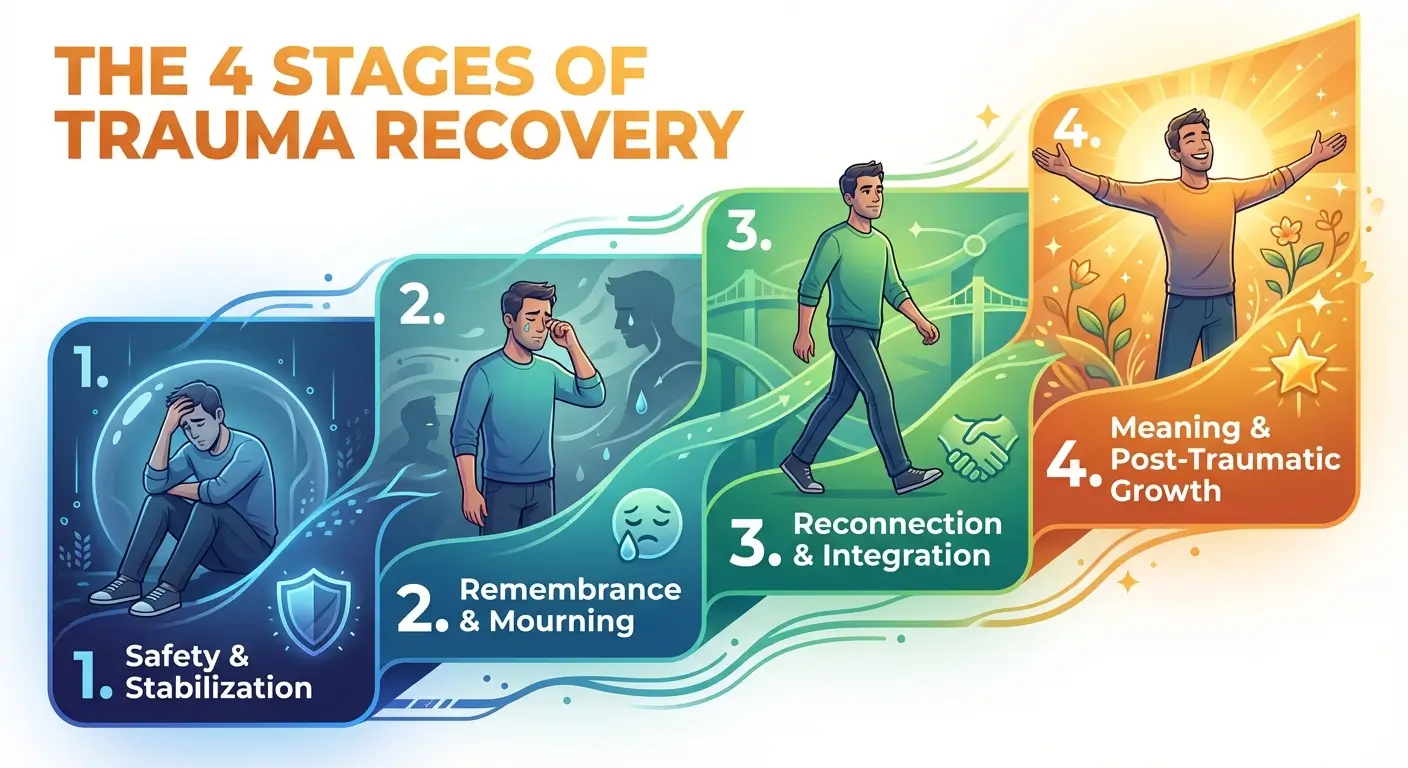
Trauma treatment has a well-established sequence, described by Judith Herman more than thirty years ago and still reflected in current practice: establish safety and stabilization first, process the traumatic material second, and integrate, rebuild identity and relationships, third.
Here is the practical problem. In early recovery, the first phase alone can take longer than an entire short-term stay. A man in his first weeks of sobriety is often sleeping badly, newly feeling emotions he has chemically managed for years, and nowhere near stabilized enough to begin trauma processing safely. Evidence-based trauma therapies such as EMDR and other trauma-focused approaches recommended in current treatment guidelines assume a stabilized client. Begin too early and the work can do more harm than good. Begin on schedule, and a 28-day program ends right around the time the real work could start.
This is the core argument for long-term care in trauma-driven addiction. Not that more time is always better, but that the established sequence of trauma treatment cannot be compressed to fit an insurance cycle. Our model, treating men since 1988, is built to give that sequence the room it requires, with trauma therapy running alongside addiction treatment rather than deferred to aftercare.
A June Checklist for Referring Clinicians
If you want to put PTSD Awareness Month to practical use, June 27 is PTSD Screening Day, and the National Center for PTSD publishes a free five-item screen (the PC-PTSD-5) that takes under a minute to administer. For clients in or considering addiction treatment, a few patterns are worth flagging:
- Repeated short stays that do not hold. Multiple discharges followed by fast relapse is often a trauma story, not a motivation story.
- Relief-seeking rather than reward-seeking use. Clients who use to sleep, to quiet their head, or to feel nothing are describing self-medication.
- A process addiction in the background. Gambling, sex, or love addiction alongside substance use raises the likelihood that trauma is underneath both.
- Anger and shutdown instead of fear. In men especially, post-traumatic stress often presents as irritability, hypervigilance, and emotional flatness rather than textbook flashbacks.
None of these is diagnostic on its own. Together, they are a reason to screen, and a reason to think carefully about whether the next placement can actually treat what the screen finds.
If You Have a Client This Describes
We should talk. Prescott House treats men whose addictions, substance and process alike, are tangled up with trauma, and our long-term model exists because that work takes time. Call us at (866) 425-2470 or email admissions@prescotthouse.com, and we will give you an honest read on whether a client is a fit, including when the answer is no.
Related Reading
More Than Willpower: A Whole-Person Approach to Addiction Recovery. The whole-person model behind treatment at Prescott House, including how EMDR fits alongside CBT and experiential therapies.
Mindfulness-Based Relapse Prevention: A Compassionate Path Through Recovery. How mindfulness practice supports the stabilization phase that trauma work depends on.
References
Pietrzak, R. H., Goldstein, R. B., Southwick, S. M., & Grant, B. F. (2011). Prevalence and Axis I comorbidity of full and partial posttraumatic stress disorder in the United States: Results from Wave 2 of the National Epidemiologic Survey on Alcohol and Related Conditions. Journal of Anxiety Disorders, 25(3), 456-465.
Khantzian, E. J. (1997). The self-medication hypothesis of substance use disorders: A reconsideration and recent applications. Harvard Review of Psychiatry, 4(5), 231-244.
Herman, J. L. (1992). Trauma and Recovery. Basic Books.
National Center for PTSD, U.S. Department of Veterans Affairs. How Common Is PTSD in Adults? ptsd.va.gov
This article is for educational purposes and is not a substitute for professional medical or mental health care. If you or someone you know is struggling with post-traumatic stress or substance use, please reach out to a qualified clinician, call SAMHSA's National Helpline at 1-800-662-HELP (4357), or, for veterans, dial 988 and press 1.
Treating what's underneath the addiction
Depression, anxiety, and trauma are treated alongside addiction from the first week, by licensed clinicians who know how the two feed each other.