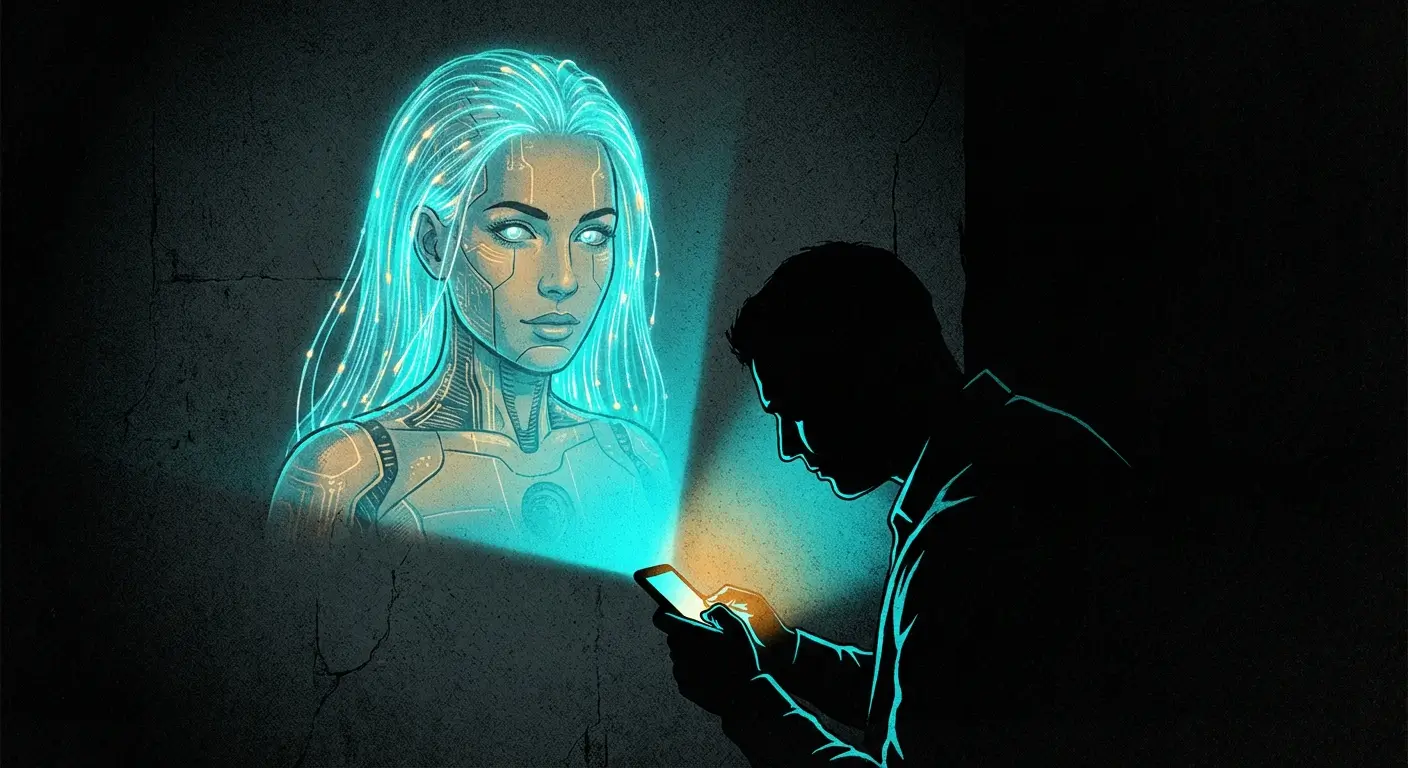
You found it by accident. Maybe a notification lit up his phone on the counter. Maybe you saw the app open late at night when he thought you were asleep. Maybe you finally scrolled through the conversations and read things he hasn't said to you in years.
When you brought it up, he said what most men say: "It's not real. It's just an app."
So why does it feel like you just found out about an affair?
You're Not Overreacting
Let's start here, because a lot of women in your position get stuck on this question before they can get to anything else.
Your reaction makes sense. You don't need a chatbot to be a person for this to hurt. What hurts is that your husband has been putting time, attention, and emotional energy somewhere other than your marriage, and keeping it from you.
You're also not alone in seeing it that way. In a July 2026 Talker Research survey of 2,000 U.S. adults, a quarter of Americans said flirting with AI counts as cheating. A Canadian study of 1,815 adults found women were about twice as likely as men to say romantic AI companion use counted as cheating. There's no consensus yet. That's partly why these conversations go sideways so fast: he's arguing about whether the app is real, and you're talking about whether he's really here.
So, Is It Cheating?
Here's the honest answer. It isn't the same as a physical affair with another woman. But it can be the same kind of betrayal.
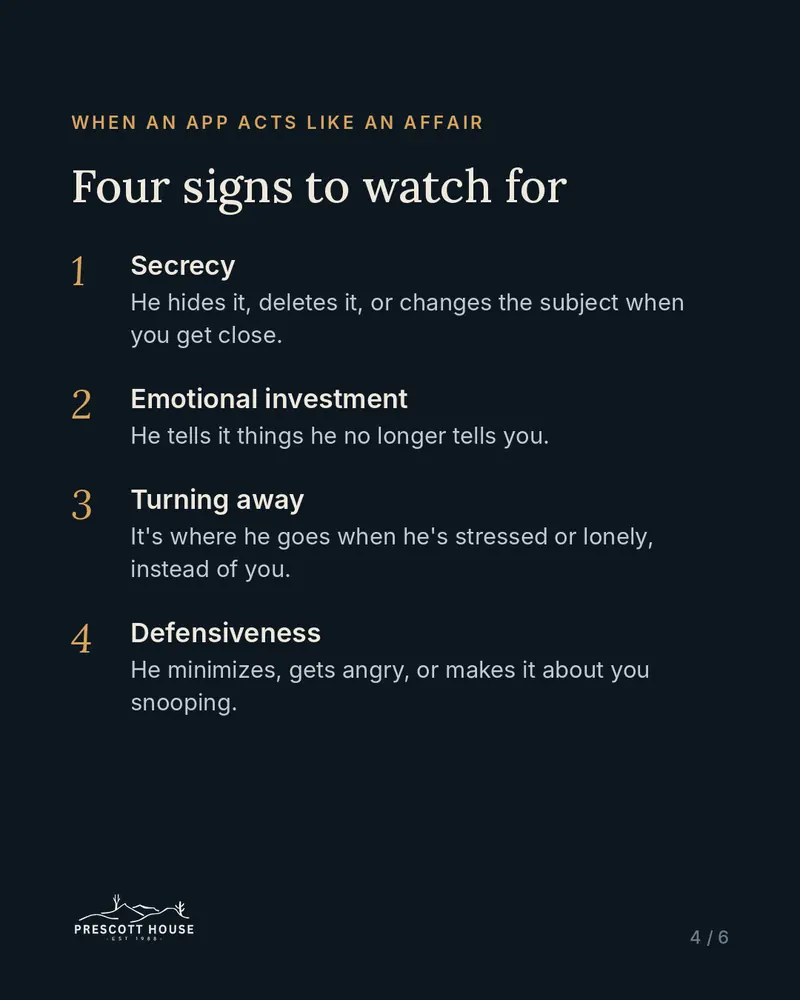
Couples therapists have talked about emotional affairs for a long time. The markers are familiar:
- Secrecy. He hides it, deletes it, or changes the subject when you get close.
- Emotional investment. He shares things with it he no longer shares with you.
- Turning away. It's where he goes when he's stressed, lonely, or bored, instead of coming to you.
- Defensiveness. He minimizes, gets angry, or makes it about you snooping.
None of those require the other party to have a pulse. If those four things are showing up in your marriage, what you're dealing with functions like an affair, whatever label he puts on it.
Why He Might Be Drawn to It
This isn't an excuse for him. It's context that might help you understand what you're looking at.
AI companion apps are built to be easy. They remember everything he says. They're always available. They never get tired, never push back, and never need anything from him. For a man who struggles to be vulnerable, that's a relationship with all the reward and none of the risk.
And men are using these apps more than women. The same Talker Research survey found men were about twice as likely as women to report romantic or sexual interactions with AI, 15% compared to 8%.
For a lot of men, the chatbot isn't really the problem. It's the newest, most convenient place to hide from feelings he's never learned to share with a real person. Sometimes that pattern looks like love addiction: chasing the rush of being understood and adored, living in fantasy, and losing interest in the slower, harder work of a real relationship. We wrote more about that side of it in When the Algorithm Loves You Back.
When It's More Than a Phase
Plenty of people try these apps out of curiosity and drop them. Here are signs it has gone past that:
- He spends hours a day on it, or it's cutting into sleep and work
- He's irritable or anxious when he can't get to it
- He has tried to stop or cut back and couldn't
- He's withdrawn from you, your kids, or his friends
- It has moved into sexual content, or it's happening alongside heavy porn use
- He keeps going even after it caused a serious fight or you told him how much it hurt
If several of those sound familiar, this probably isn't something a promise to delete the app will fix.
How to Bring It Up
The goal isn't to win the argument about whether AI is real. You'll lose that one, because he'll keep moving the conversation there. Keep it on what's happening between the two of you.
- Pick a calm moment. Not right after you find something, and not late at night.
- Talk about the marriage, not the app. "I feel like you're somewhere else, and I found out where" lands differently than "you're cheating on me with a robot."
- Be specific. The hours, the secrecy, the conversations you read. Facts are harder to brush off than feelings.
- Say what you need. Honesty about how much he uses it. Willingness to talk to someone. Whatever is true for you.
- Expect defensiveness. Shame often comes out as anger or minimizing. That doesn't mean you were wrong to raise it.
What You Can Do for Yourself
You can't make him get help. But you don't have to wait for him to be ready before you get support.
Talk to someone you trust. Consider a therapist of your own, ideally one familiar with betrayal trauma or sex and love addiction. And know that discovering something like this can bring up the same shock, anxiety, and second-guessing as any other kind of betrayal. That's a normal response, not a sign you're being too sensitive.
We built a page specifically for partners in your position: Help for Partners. It covers what's happening to you, not just to him.
If He's Ready for Help
At Prescott House, we treat men for love addiction, intimacy problems, and the compulsive behavior that grows out of them. The work goes after what's underneath: the shame, the old wounds, and the fear of being truly known that made a chatbot feel safer than his own wife.
Families are part of that work. Our family involvement program gives partners a place in the process, with their own support along the way.
If you're not sure whether he needs treatment, you can start with our sex and love addiction self-assessment.

And you can call us even if he isn't ready. A lot of men come to us because their partner made the first call.
Call (866) 425-2470 or verify insurance here.
References
- Talker Research survey of 2,000 U.S. adults, July 2026, via KPC News
- Canadian survey of 1,815 adults on romantic AI companions, via News Arena
Help for compulsive sexual behavior, porn, and love addiction
Our CSAT-led program for men treats the shame, trauma, and intimacy problems underneath the behavior. Partners can call us too, even if he isn't ready.