Gambling and Adderall: How Stimulants Quietly Fuel the Urge to Bet
There is a conversation that happens in our admissions office more often than people would expect. A man calls about a gambling problem. Somewhere in the first twenty minutes, almost in passing, he mentions that he also takes Adderall. Sometimes prescribed. Sometimes not. Sometimes both, at different points in the story.
And then the admissions counselor pauses. Because once you have had this conversation a few hundred times, you stop thinking of gambling and Adderall as two separate problems that happened to land in the same person. You start thinking of them as a pattern.
This is not just an annomolly seen here at Prescott House. This is becoming more widely known as this video from FOX 9 Minneapolis-St. Paul Shows.
This post is about that pattern: what the research actually says, why the combination is so easy to miss, and what it usually takes to untangle.
Why Gambling and Adderall Keep Showing Up Together
Adderall is an amphetamine. That is not a controversial statement, it is simply what it is. It works by flooding the brain with dopamine and norepinephrine, two chemicals that sharpen focus, lift mood, and make effort feel more rewarding. For someone with ADHD, that chemistry brings a scattered mind into coherence. For someone without ADHD, or someone taking more than prescribed, it does something else entirely. It turns the brain's reward system up.
Gambling also works on the brain's reward system. Every near-miss, every push of a button on a slot app, every live-bet tick on a basketball game is engineered to produce a small, unpredictable dopamine spike. That unpredictability is the whole point. It is what keeps a person pulling the lever long after the rational mind has left the building.
Put a stimulant on top of that system and you are not adding two things together. You are multiplying them.
The Dopamine Loop: What Adderall Actually Does in the Brain

A 2003 study published in Neuropsychopharmacology gave problem gamblers a 30 mg dose of oral amphetamine in a placebo-controlled design. The result was striking: amphetamine specifically increased motivation to gamble and primed gambling-related thinking. Reading speed for gambling words went up. Reading speed for neutral words went down. The drug was not making them generally more excited. It was making them more specifically tuned to gambling.
That is the piece most people miss. Amphetamine does not just make a person feel good. It makes the gambling cues in their environment feel more magnetic, more urgent, more worth responding to. A sports betting notification that would normally get ignored at 11 p.m. becomes the most interesting thing on the phone.
Researchers describe this as "incentive salience" — the brain's tendency to assign outsized importance to cues associated with reward. Stimulants amplify it. Gambling depends on it. You can see why the combination creates a particularly slippery situation.
What the Research Actually Shows
The clinical literature on stimulant use and gambling has grown considerably in the last decade, and the findings are consistent in direction if not always in size.
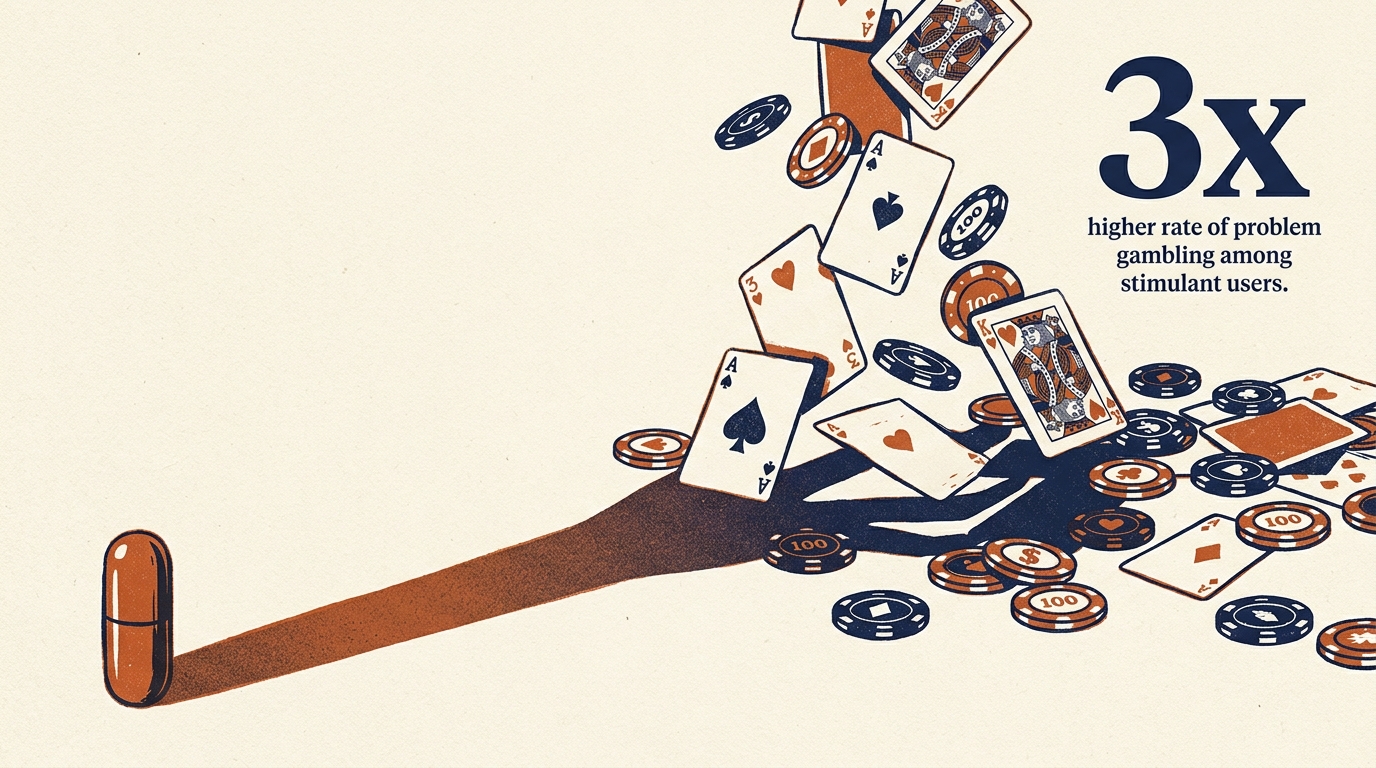
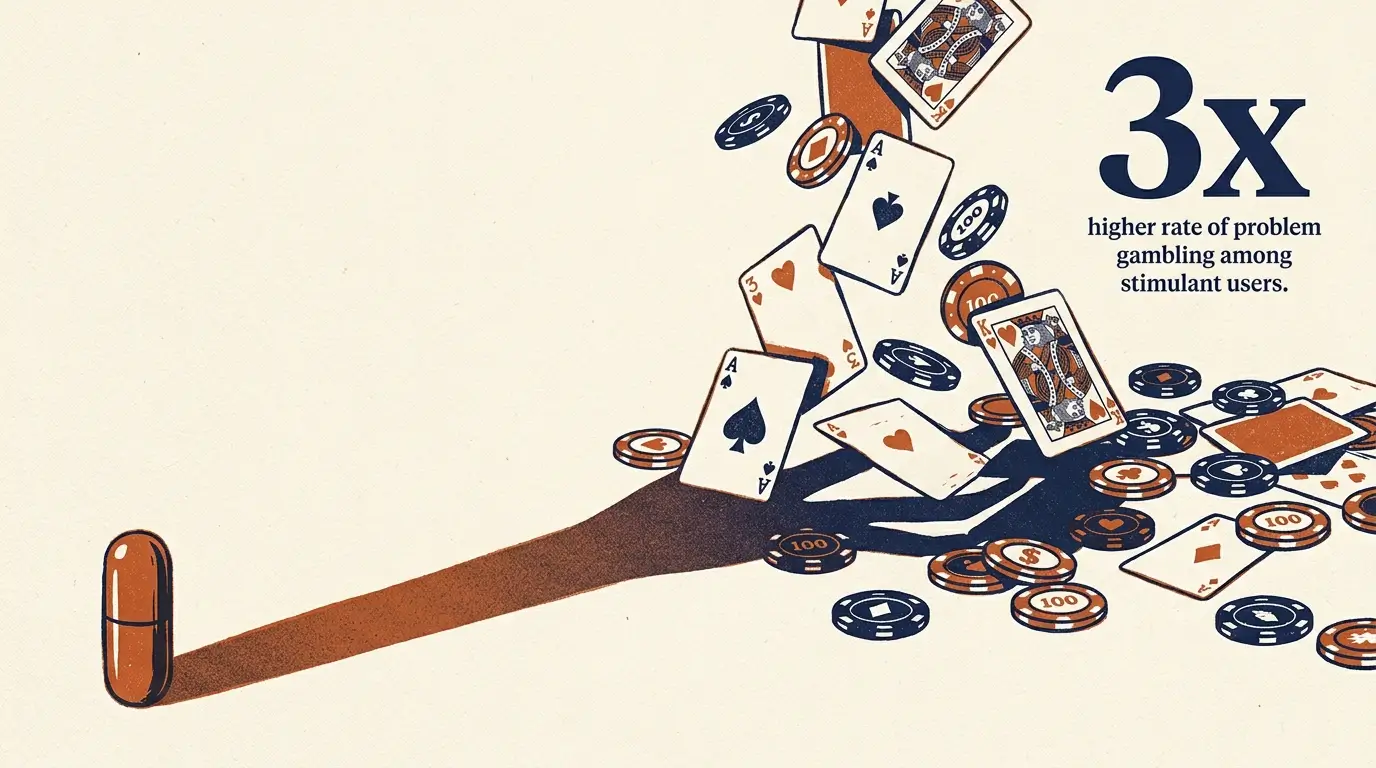
A study of college students published in a peer-reviewed journal found a three-fold higher rate of recent problem gambling among those who used stimulants compared to those who had not (11% versus 4%). Stimulant use at baseline also predicted higher gambling frequency and a trend toward greater gambling losses twelve months later, even after controlling for other risk factors.
A 2023 review in Pharmaceutical Medicine examining drug-induced gambling disorder concluded that dopaminergic medications, including amphetamines and methylphenidate, have been meaningfully linked to new-onset or worsening gambling behavior in vulnerable individuals. The FDA label for Adderall itself includes a warning about abuse, misuse, and addiction, and the broader class of stimulants has a documented history of unmasking impulse-control problems in people who were previously fine.
None of this means everyone who takes Adderall will gamble. That is not the claim. The claim, supported by the evidence, is that Adderall can measurably raise the ceiling on gambling motivation in a person whose wiring is already inclined in that direction. And that description fits a lot more people than most clinicians initially assume.
The ADHD Piece No One Wants to Talk About
Here is where the picture gets genuinely complicated. ADHD and gambling disorder are comorbid at high rates, independent of any medication. The impulsivity, the sensation-seeking, the difficulty holding future consequences in mind during a present-moment decision — these are features of ADHD that also happen to be risk factors for problem gambling.
So when a man with untreated ADHD starts taking Adderall and his gambling escalates, there are two competing explanations. One is that the medication is priming his reward system. The other is that the medication is helping him focus intensely on something that happens to be harmful. Both can be true at once. Usually are.
This is also why the clinical picture does not clear up by simply stopping the Adderall. The underlying vulnerability to gambling was there first. The stimulant amplified it. Pulling the stimulant out of the equation reduces one input to the loop but leaves the other one running.
Treatment has to address both.
When Sports Betting Meets a Prescription
The cultural context around this has shifted dramatically. Sports betting is legal in thirty-plus states. A wager takes three taps. A 2025 analysis found that nearly one in ten sports bettors now meets clinical criteria for gambling addiction, and young men aged 18 to 34 show the highest prevalence at 13.4 percent.
That same demographic also represents the largest share of non-prescription Adderall use. College campuses have normalized the drug as a study aid for two decades. Among students using stimulants recreationally in recent surveys, more than half report that the pills are not prescribed to them.
So consider what that overlap actually looks like on a Tuesday night during the NBA playoffs. A twenty-six-year-old takes a friend's 20 mg dose of Adderall to finish a project. Halfway through the project, he pulls up DraftKings. He was going to place one small bet on the game he is half-watching. Four hours later, he is still awake, still betting, chasing losses that have climbed past rent.
That story is not rare. It is, in some ways, the defining addiction story of this decade.
Warning Signs That Adderall and Gambling Have Become a Problem
Both substances can hide well, and they hide each other better. A person can function at work, keep relationships intact, and appear to have everything handled while the problem compounds underneath. Still, certain signs tend to cluster when the two are feeding each other.
On the Adderall side: taking more than prescribed, seeking prescriptions from multiple providers, using other people's medication, feeling unable to focus or function without it, insomnia that has become routine rather than occasional, irritability and anxiety in the off-hours, weight loss, and using the drug in contexts it was never intended for — like staying up all night betting.
On the gambling side: gambling with increasing amounts to get the same excitement, restlessness when trying to cut down, lying about how much has been wagered or lost, borrowing money to gamble or to cover gambling debts, gambling to escape distress, and chasing losses rather than accepting them.
When both sides are present, the clusters reinforce one another in ways that are hard to interrupt alone. The Adderall makes the late-night betting sessions possible. The betting sessions make the next day's Adderall feel necessary. The cycle tightens.
Treating Gambling and Adderall Together (Not Separately)
The common mistake in treatment is to triage one and postpone the other. A man enters a program for gambling addiction and the stimulant question gets treated as a medical footnote. Or he enters a program for stimulant misuse and the gambling behavior is filed under "associated financial stress."
Neither approach works for long. Because both live in the same reward circuitry, progress on one without addressing the other tends to leave the loop intact. The person gets clean from Adderall and the gambling urges remain intense. Or the person stops gambling and the stimulant use starts creeping up to fill the dopamine gap.
Effective treatment for this co-occurrence generally involves a few things working in concert. A proper clinical assessment that takes both behaviors seriously from day one, not as one primary and one secondary. Medical evaluation of the stimulant use, including an honest conversation about whether an ADHD diagnosis is accurate, whether the current dose is appropriate, and whether a non-stimulant alternative deserves consideration. Cognitive-behavioral therapy tailored to impulse-control disorders, which is the most evidence-supported psychotherapeutic approach for both substance use and problem gambling. Peer support through groups like Gamblers Anonymous and the recovery community more broadly, which provides something no clinical intervention alone can. And a long enough runway for the brain's reward system to recalibrate, which is rarely the twenty-eight days the insurance industry prefers.
At Prescott House, our long-term residential program for men is built for exactly this kind of tangled presentation. The ninety-plus day length of stay is not a marketing choice. It is a clinical one. Co-occurring stimulant misuse and behavioral addiction do not resolve on a short timeline, and the outcomes data on long-term residential care for these profiles is why we structure the program the way we do.
If You Are Reading This for Someone You Love
Most of the calls that start these conversations do not come from the person using. They come from a mother who found a betting app receipt. A wife who noticed the Adderall bottle empty two weeks early. A brother who got asked for a loan again.
If that is you, a few things are worth knowing. You did not cause this. You cannot control it by managing harder. And you are not overreacting for recognizing a pattern that has a name.
The people in our lives with these co-occurring problems are often genuinely high-functioning, which makes the concern easier to dismiss and harder to raise. But stimulant-fueled gambling tends to escalate, not plateau. The sooner it is named, the more options there are.
Reaching out is not a final step. It is a first one. A conversation with an admissions counselor does not commit anyone to anything. It simply opens a door that might have felt closed.
If you or someone you love is caught in this loop, we are here to talk. Reach out to our team or learn more about the Prescott House gambling addiction treatment program. For questions about stimulant or substance misuse, our drug and alcohol rehab program addresses both sides at once.
📚 Sources & Further Reading
- Amphetamine Primes Motivation to Gamble (Neuropsychopharmacology, 2003) — The foundational study on how amphetamine specifically increases gambling motivation in problem gamblers.
- Drug-Induced Gambling Disorder: Epidemiology, Neurobiology, and Management (Pharmaceutical Medicine, 2023) — A comprehensive review of how dopaminergic drugs, including stimulants, contribute to gambling behavior.
- Exploring the Relationship between Stimulant Use and Gambling in College Students — The peer-reviewed study documenting a three-fold rise in problem gambling among stimulant users.
- When ADHD and Substance Use Disorders Coexist (CHADD) — Overview of the ADHD-substance use connection from a leading ADHD advocacy organization.
- National Council on Problem Gambling Helpline — 24/7 confidential help at 1-800-GAMBLER.
- FDA Adderall Prescribing Information — The full label including boxed warning on abuse, misuse, and addiction.
Related Prescott House Readings
- Winning the Bet Against Yourself: Understanding Sports Betting Addiction Statistics in 2025 — A deep look at who is betting, how much, and what it is costing. Read more →
- Take Back the Game: Why Arizona's New Self-Exclusion Campaign Is a Win for Recovery — On the self-exclusion tools available to Arizonans. Read more →
- Gambling Addiction Treatment at Prescott House — Program overview and what treatment actually looks like. Read more →
- Long-Term Addiction Treatment in Arizona — Why ninety-plus days matters for co-occurring presentations. Read more →
A dedicated gambling recovery track for men
Long-term residential care with trauma-informed clinicians, for men whose gambling has taken over and the families dealing with the damage.