When most people think of trauma, they picture a single catastrophic moment. But in addiction and intimacy disorders, it rarely works that way.
For the person struggling with addiction, trauma is often quieter — unresolved childhood wounds that never fully healed, driving the need to numb out with substances or pornography. For their partner, it can arrive all at once: the devastating discovery of a secret life, a betrayal that reshapes everything they thought they knew.
Either way, the aftermath feels the same. Your nervous system is overwhelmed. Trust is gone. Getting through a single day takes everything you have.
Here's what most people don't realize: healing isn't just a matter of time. It's a process — and it has a shape. Clinical professionals recognize a clear, structured pathway that moves people from survival to genuine recovery. Understanding the 4 stages of trauma recovery gives you a map when everything feels like chaos. It tells you where you are, why you feel the way you do, and — most importantly — that there is a way through.
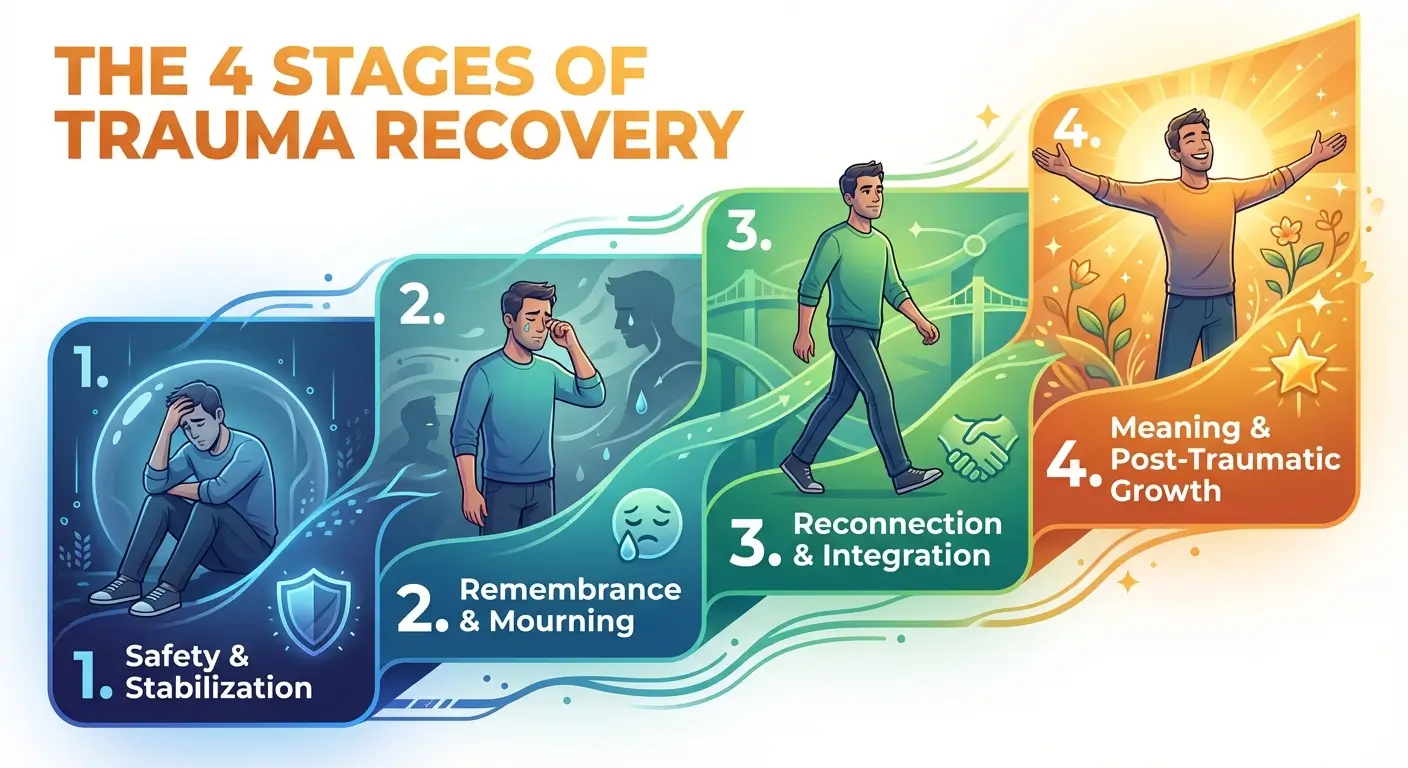
The 4 Stages of Trauma Recovery
Stage 1: Safety and Stabilization
Trauma's first casualty is your sense of safety. That's why the first step in recovery is never deep emotional processing — it's stopping the bleeding.
Before the nervous system can begin to heal, the active crisis has to end. In the context of intimacy disorders, the brain is locked in survival mode — sometimes expressing that as emotional shutdown, physical withdrawal, or complete disconnection from the people closest to you. A partner experiencing betrayal trauma, for example, may find themselves pulling away physically entirely. This is known as sexual anorexia — not a choice, but a protective response the nervous system makes to avoid further vulnerability.
The goal of this stage is simple but foundational: ground the nervous system, establish clear boundaries, and reclaim a sense of control over the present moment. Nothing deeper can happen until this is in place.
Stage 2: Remembrance and Mourning
Once you feel safe enough, the harder work begins — and it starts with grief.
For the person in recovery, this means mourning the loss of the addiction itself. As destructive as it was, it served a purpose. It numbed something. Letting it go is a real loss, and it deserves to be treated like one. For the betrayed partner, this stage means grieving the relationship they thought they had — the version of their life that turned out not to be true.
This isn't about reliving the trauma on a loop. It's about giving the pain a voice in a safe, clinical setting — processing the anger, the sadness, and the confusion until they no longer have a grip on your daily life. You can't outrun grief. But you can move through it.
Stage 3: Reconnection and Integration
Trauma isolates. It cuts you off from your body, your relationships, and your own sense of who you are.
Stage three is where you start to come back.
By this point, the trauma is no longer the center of your story — it becomes part of your history, something that happened to you rather than something that defines you. Therapies like EMDR (Eye Movement Desensitization and Reprocessing) and CBT play a significant role here, helping rewire the neural pathways that kept the trauma response active long after the crisis ended.
This is the stage where trust starts to return — first in yourself and your own judgment, then carefully and intentionally with others. Healthier coping mechanisms replace the old ones. Authentic connection begins to feel possible again.
Stage 4: Meaning and Post-Traumatic Growth
The final stage doesn't erase what happened. It transforms what you do with it.
Post-traumatic growth isn't about being grateful for the pain. It's about discovering that you are more resilient, more self-aware, and more capable of genuine connection than you were before — because of what you survived, not in spite of it.
At Prescott House, we see this stage every day. It looks like a man stepping out of years of shame for the first time. It looks like a marriage beginning to heal. It looks like someone building a life grounded in honesty, accountability, and real intimacy — not the counterfeit version the addiction offered.
That transformation is what all four stages are moving toward. And it's available to you.

How to Actually Use This Framework in Your Healing
Reading about the 4 stages of trauma recovery is useful. Knowing how to apply them to your actual life is where the real work begins. Here's how to use this roadmap in a way that genuinely moves you forward.
1. Stop judging your timeline.
Healing is not linear — and it's not a race. You might reach Integration and then find a single trigger pulling you back into Safety and Stabilization for a few days. That's not failure. That's not a setback. That's just how the brain processes trauma.
Knowing the stages gives you something most people in recovery desperately need: a way to have a bad day without deciding that everything is broken.
2. You can't skip steps — so stop trying.
One of the most common mistakes in both addiction and betrayal recovery is trying to sprint straight to Stage 4. The desire to get to meaning and growth makes complete sense. But you cannot process deep relational trauma or rebuild trust while active addiction or deception is still happening. The foundation has to come first. Every time.
3. Build a shared language with your partner.
If you're navigating this as a couple, these stages give you something invaluable — a way to communicate what's happening inside you without it turning into a fight. There's a significant difference between a reactive argument and saying: "My nervous system is overwhelmed right now. I'm in Stage 1 and I need to focus on safety today."
One escalates. The other opens a door.
4. Match your support to your stage.
Knowing where you are in the process helps you get the right kind of help — not just any help. Stage 1 calls for crisis support, boundary work, and stabilization. Stage 3 is when you're ready for deeper trauma processing like EMDR or trauma-focused CBT. Jumping to the wrong intervention too early doesn't accelerate healing — it can actually stall it.
If you're unsure which stage you're in, that's exactly what a CSAT-trained therapist is equipped to help you figure out.
Trusting the Process of Healing
Healing from trauma — whether that means uncovering the roots of an intimacy disorder or finding your footing after the shock of betrayal — is one of the hardest things you will ever do.
It is also entirely possible.
The four stages of trauma recovery aren't a clinical theory invented in a textbook. They are a lived pathway — one that thousands of men and their partners have already walked. The chaos you feel right now has a shape. And that shape has a way through.
Understanding where you are in the process changes everything. It lets you stop fighting your own timeline. It gives you permission to have hard days without losing sight of where you're headed. And it helps you focus your energy on the right work for the stage you're actually in — not the stage you wish you were in.
You don't have to have it all figured out today. You just have to take the next right step.
Begin Your Healing Journey
Trauma and addiction don't have to be the end of your story. At Prescott House, we specialize in exactly this work — helping men and their partners move through each stage of recovery with clinical expertise, genuine compassion, and a clear path forward.
If you or someone you love is struggling with intimacy disorders, betrayal trauma, or compulsive behaviors, we're here to help.
Ready to Find Help?
If you or a loved one are struggling and looking for professional support, our specialized treatment programs are designed to help you reclaim your life. Explore our core programs below:
- Men’s Mental Health Treatment in Arizona
- Men’s Dual Diagnosis Treatment
- Stop Treating the Symptom: Men’s Dual Diagnosis Treatment
- Men's Trauma & PTSD Treatment: Healing the Root Cause with EMDR
📩 Verify Insurance Benefits (Quick & Confidential)
Explore More on Mental Health
If you are looking for more information, research, or wellness tips, we have curated a list of our latest guides and articles to help you navigate these complex topics.
Essential Guides & Statistics
- Mental Health Disorder Statistics: A Global Overview
- A Guide to Different Therapy Types & Choosing the Best Fit
- Online Therapy vs. In-Person Sessions: Pros & Cons
Understanding Trauma & Addiction
- Understanding the Link Between Trauma and Substance Abuse
- Breaking the Cycle: Healing from Toxic Codependency
- Gambling Addiction in the Spotlight
Wellness & Lifestyle
- 5 Ways Therapy Can Boost Your Overall Wellbeing
- Mindfulness Techniques for Managing Mental Health Symptoms
- The Sobriety Movement: Embracing a Sober Lifestyle
- Social Media Addiction: What It Is & How to Cope